Turn-Based Tactics for Beginners: Cover, Flanking and AP
New to turn based tactics? Learn cover, flanking, hit chance and action economy with clear examples, plus the habits that win battles in any tactics game.

Turn based tactics games are about a few big ideas: get behind cover, attack from angles the enemy can’t protect, and squeeze value out of every action. Learn those, and you’ll win more battles in almost any game in the genre.
This guide explains each idea in plain terms. For examples, we’ll use the rules of Gang Tactics, the street-crew strategy game we’re building at HulaGames. It’s coming soon, and its battle rules are written with exact numbers, which makes it a handy way to see the math behind the genre. Treat those numbers as the current design, since they may be tuned before launch.
What makes a game “turn-based tactics”?
A turn-based tactics game gives you a small team on a map, usually a grid. Instead of everyone acting at once, units take turns. On each turn, you decide where a unit moves and what it does, then the game resolves it before the next unit goes.
That turn structure is the whole appeal. There’s no rush. You can look at the board, think about what the other side might do, and make a plan. The challenge comes from limits: each unit can only do so much per turn, and attacks don’t always land.
In Gang Tactics, you command a crew of three (a Gunner, a Brawler and a Doctor) against a rival crew of three to five on a grid map of a city block.
Action economy: the hidden heart of tactics
“Action economy” means how many useful things your team gets to do compared to the other side. Every unit has a budget per turn, and the way you spend it matters more than almost anything else.
How action points work
Many tactics games use action points (AP). In Gang Tactics, every unit gets 2 AP per turn, and anything unspent is lost. Moving costs 1 AP. Attacking costs 1 AP and ends the turn.
That creates a simple, very important pattern:
- Move, then attack. Use your first AP to get into a good spot, then attack with the second.
- Move, then move. Use both AP to cover a lot of ground when you need to reposition.
- Attack first only if you’re already in the right place. Because attacking ends your turn, you can’t attack and then run back to safety.
The game helps you plan: tiles you can reach with 1 AP light up blue, and tiles that need both light up yellow.
Free actions are gold
Some actions don’t end your turn. In Gang Tactics, using your Medkit costs 1 AP but doesn’t end the turn, so a unit can patch up and still move. Knowing which actions end a turn, and which don’t, lets you fit more into each one.
Key takeaway: before you act, ask “is this the best use of this AP?” A wasted action is a turn you gave the other side.
Initiative: who goes when
Not every tactics game alternates “my team, then their team.” Some, like Gang Tactics, use Initiative: every unit has a number, and the highest goes first, mixing both sides into one turn order. Ties go to your crew.
That order is shown as a bar of portraits, and it’s worth reading every turn. If you can see that a rival Thug acts right after your Doctor, you know not to leave the Doctor somewhere that Thug can reach.
In Gang Tactics’ starting numbers, the Brawler has the highest Initiative on the crew, so they often get to act early.
Cover: your best friend
Cover is anything that blocks or partly blocks attacks. Most tactics games have two levels, and Gang Tactics does too:
| Cover | Examples | Hit chance penalty for the attacker |
|---|---|---|
| Half cover | Crates, cars, low walls | -20 |
| Full cover | Walls, pillars, trucks | -40 |
| Open ground | No cover nearby | 0 |
On a grid, cover usually sits on the edges between tiles, shown with shield icons. A unit standing next to a crate gets cover on that side.
Cover has a direction
This is the part beginners miss. Cover only protects you from the direction it faces. A crate to your north protects you from attackers to the north, not from someone standing to your east.
In Gang Tactics, an edge counts against an attacker when the attacker is in front of it, at least one tile out, and not too far off to the side. If two of your cover edges both count, you get the stronger one. Cover never stacks, so two crates are no better than one.
Always end your move in cover
The simplest rule in the genre: if you can reach cover, end your move there. Standing in the open hands the other side a free, high-chance attack.
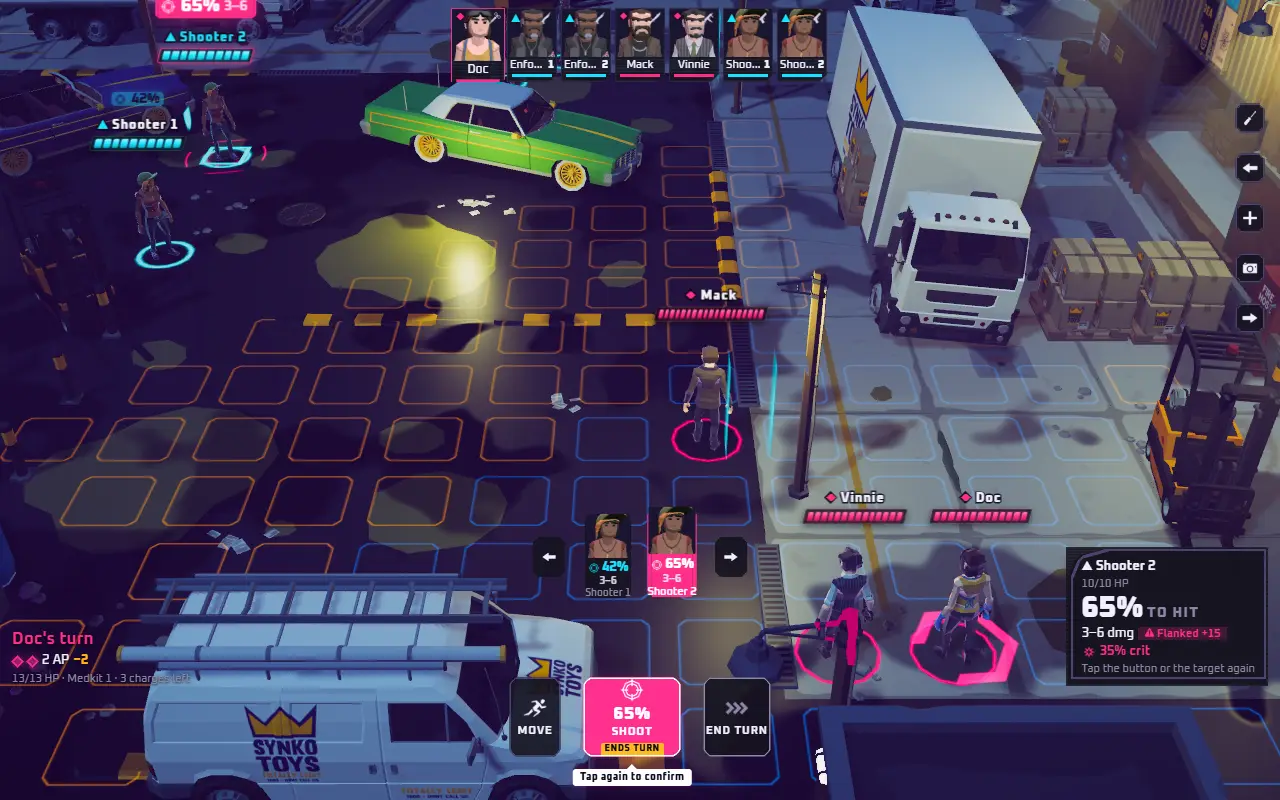
Flanking: getting around cover
If cover protects from one direction, the answer is to attack from another. That’s flanking.
In Gang Tactics, a target is flanked when it’s next to cover but none of that cover faces you. A flanked target doesn’t just lose its protection, it gives you a +15 bonus to hit. A target standing in the open, with no cover at all, gets neither bonus nor penalty.
Here’s how much angle matters, using the Gunner’s starting aim of 70%:
| Gunner attacks a target that is… | Hit chance |
|---|---|
| In full cover | 70 - 40 = 30% |
| In half cover | 70 - 20 = 50% |
| In the open | 70% |
| Flanked | 70 + 15 = 85% |
Same unit, same target. The only difference is where everyone is standing. That’s why good tactics players spend so much time on movement.
Flanking cuts both ways. If your crew is bunched behind one wall, a rival who walks around the end of it can flank all of them. Spread out a little, and watch your sides.
Hit chance, range and line of sight
Range
Every attack has a range. In Gang Tactics, you can still attack a little past your weapon’s range, but you lose 3 points of hit chance for each tile past it, up to 4 tiles. Beyond that, no attack. Hit chances are kept between 5% and 95%, so nothing is ever a sure thing either way.
Line of sight
You can’t hit what you can’t see. Gang Tactics uses a peek rule: a unit behind a single pillar or vehicle can lean out to attack and can be targeted the same way, while a unit against a long wall can’t be seen from the far side at all. Half cover never blocks line of sight; it just makes you harder to hit.
Units don’t block line of sight, and there’s no friendly fire, so you don’t have to worry about attacking past your own crew.
Close range is different
Most tactics games treat close-up attacks differently. In Gang Tactics, melee needs an adjacent tile (up, down, left or right, no diagonals), hits at a flat 90% and ignores cover. Anyone can do it, but the Brawler hits much harder up close than anyone else.
Healing and getting knocked down
Health in tactics games is a resource to manage. Gang Tactics gives every crew member one Medkit, and the Doctor has three shared charges for Heal (help an adjacent ally) and Revive (get a downed ally back up).
When a crew member’s health hits zero, they’re downed, not gone. They have two of their own turns for the Doctor to reach them. If the rival crew hits them again first, they’re out of the battle. Keeping the Doctor safe and close enough to help is a big part of winning.
Seven habits of good tactics players
- End every move in cover when you can reach it.
- Read the turn order before you commit.
- Move first, attack second.
- Hunt for flanks and protect your own.
- Focus your attacks. Taking one rival out of the fight removes all of their future actions. Spreading damage around removes none.
- Keep your healer close but not in front.
- Check the preview. In Gang Tactics, every action shows its cost, hit chance and damage before you confirm, and the number shown is the real number.
Try it yourself
Gang Tactics isn’t out yet, but you can read more about the game in our Gang Tactics first look and see each role’s job in Building Your Crew.
If you want a strategy fix today, Jungle Duel is a strategy card game in your browser where timing and board control decide the match. Browse everything that’s live on our games page.
FAQ
What is a turn-based tactics game?
It’s a strategy game where you control a small team on a map, usually a grid, and units take turns instead of acting in real time. You win by positioning well, using cover and spending each unit’s actions wisely.
What does flanking mean in tactics games?
Flanking means attacking a unit from a side its cover doesn’t protect. Most tactics games reward it with a better hit chance, and in Gang Tactics a flanked target gives the attacker a +15 bonus in the current design.
What is action economy?
Action economy is how much each unit can do per turn and how well you use it. Spending every action on something useful, and making sure the enemy wastes theirs, is often the difference between winning and losing.
Is half cover worth it?
Almost always. In Gang Tactics, half cover takes 20 points off an attacker’s hit chance in the current numbers. Ending a move in the open when cover was reachable is one of the most common beginner mistakes.
Can I play Gang Tactics now?
Not yet. Gang Tactics is our turn-based tactics game, and it’s coming soon to HulaGames in your browser, built for phones first.