Free Rummy Game Online: Rummy Variations Worth Knowing
Looking for a free rummy game online? Here's how the main rummy variations work, how phase-based rummy differs, and where to play one free in your browser.
If you’re looking for a free rummy game online, you have more choices than you might think, because “rummy” is really a whole family of games. They share one core idea (draw a card, build sets and runs, discard), then twist it in different directions. Some are built for two players, some for a crowd, and some give you a new goal every round.
This guide gives you a quick tour of the main variations so you can pick the style you’ll enjoy. Then we’ll show you how phase-based rummy works, since that’s the style of Number Phase, our free rummy-style game that plays in your browser.
What all rummy games share
Nearly every rummy game uses the same building blocks:
- Sets: cards of the same rank, like three Queens.
- Runs: cards in sequence, like 6-7-8. With a regular deck, runs are usually in one suit.
- Draw and discard: each turn you take a card and give one back.
- Going out: play or match all your cards to end the round.
Points usually count against you for cards stuck in your hand. If sets and runs are new to you, our guide to sets vs. runs explains them with examples.
The main rummy variations
Basic rummy
The starting point. Players are dealt a hand, then take turns drawing from the stock or the discard pile, laying down sets and runs, and discarding. Many versions let you add cards to groups already on the table. First to go out wins the round, and everyone else scores their leftover cards against them.
It’s the best place to start if you’ve never played any rummy.
Gin rummy
A two-player classic. Each player gets ten cards, and you build your hand privately instead of laying groups down as you go. Cards that aren’t in a set or run are called deadwood. When your deadwood is low enough (10 points or less in the standard rules), you can knock to end the hand. Go out with no deadwood at all and you’ve made gin, which earns a bonus.
Gin is tight and tactical. Every discard tells your opponent something.
Rummy 500
In Rummy 500, the groups you lay down score points for you, and cards left in your hand count against you. You can also take more than one card from the discard pile, as long as you use the deepest card you took right away. The first player to reach 500 points wins.
It’s a good choice if you like a running score more than going out first. Because you can dig into the discard pile, it also rewards a good memory for what’s been thrown away, and games tend to swing late as players lay down big groups.
Canasta
Canasta is played with two decks plus jokers, usually in partnerships of two. Instead of runs, you build melds of the same rank, and a meld of seven cards is a canasta, which scores a big bonus. Wild cards help, but too many can spoil a meld’s value.
It’s a longer, social game, often played over an evening.
Contract rummy
Contract rummy is played over a set number of deals, and each deal has a “contract”: a required combination such as two sets, or a set and a run. The contracts get harder as the game goes on. Everyone works on the same contract in the same deal, and you have to meet it before you can lay anything down.
This is the closest cousin to phase-based rummy.
How phase-based rummy is different
Phase-based rummy takes the contract idea and makes it personal. Instead of everyone moving through the contracts together, each player climbs their own ladder of goals, called phases.
- Complete your phase during a round and you move up to the next one.
- Miss it and you stay on the same phase for the next round.
- Each phase asks for a different shape, mixing sets, runs and other groups.
That one change creates a lot of drama. Two players at the same table can be several phases apart, a leader can stall on a tough phase, and a player who’s behind can catch up with a couple of good rounds.
Key takeaway: in phase-based rummy, the round’s goal is different for each player, so you’re always racing your own ladder and watching everyone else’s.
| Variation | Players | What makes it different |
|---|---|---|
| Basic rummy | 2 or more | The simple core: sets, runs, go out first |
| Gin rummy | 2 | Private hands, knocking and deadwood |
| Rummy 500 | 2 or more | Melds score for you, race to 500 |
| Canasta | Usually 4 in pairs | Same-rank melds, seven-card canastas |
| Contract rummy | 3 or more | A shared, harder contract each deal |
| Phase-based rummy | 2 to 6 in Number Phase | Each player climbs their own ten phases |
Number Phase: a free phase-based rummy game
Number Phase is our take on phase-based rummy. It’s free in your browser on phone or desktop, with no ads, no purchases and no energy timers, and you don’t need an account to start.
Here’s how it plays:
- Ten phases built from sets, runs and a color phase. Finish the Final Phase with the lowest score to win.
- Its own 112-card deck: numbers 1 to 12 in four colors (two of each), 12 Wilds and 4 Skips.
- A simple turn: draw, lay down your phase if you can, add cards to groups on the table, then discard.
- Penalty points for cards left in your hand when someone goes out.
Ways to play
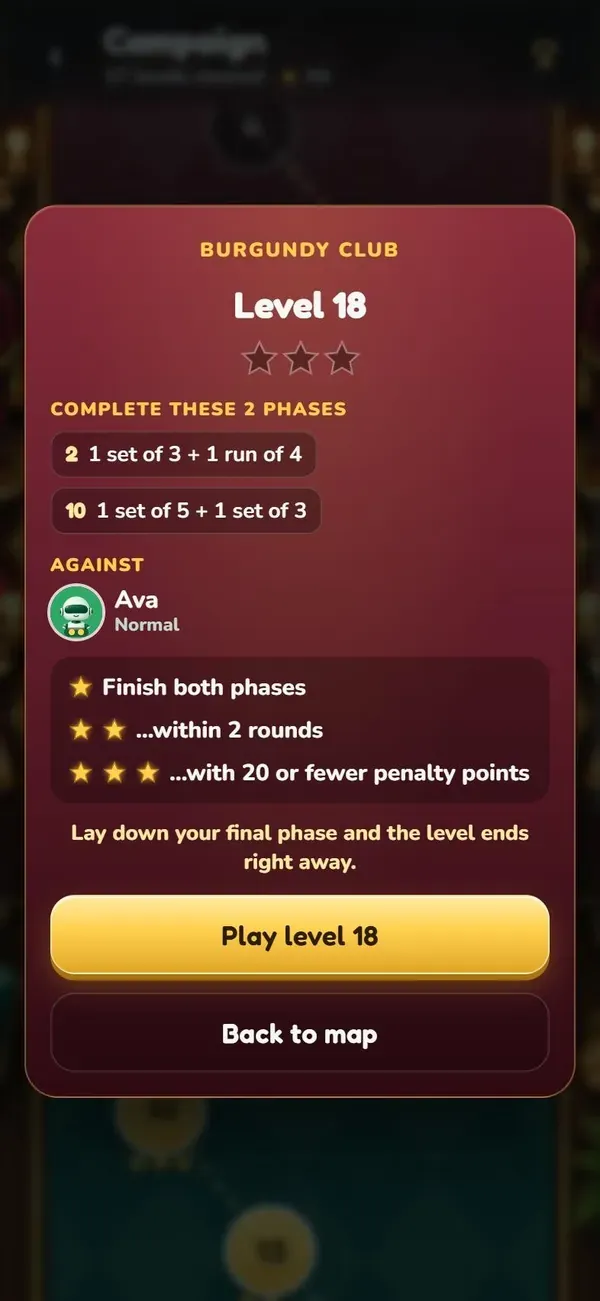
- Campaign: an endless road of tables against robot rivals, with stars, felts and card backs to earn, and a boss every 15th level.
- Quick game: five phases against bots in about eight minutes.
- Custom game: all ten phases against up to five bots, about 20 to 30 minutes.
- Pass-and-play: two to six people share one phone, with a hand-off screen that hides each hand. Online play isn’t available yet.
It’s built for one-handed play on a phone. On iPhone you can add it to your Home Screen to open it full-screen. Drag cards into slots, or select them and tap. Tap Suggest to fill your phase, and the hints tell you when you’re one card away.
Which rummy should you play?
- Want a two-player duel? Gin rummy.
- Want a long, social evening? Canasta.
- Want a fresh goal every round and a game that plays well solo? Phase-based rummy.
If that last one sounds good, our how to play guide covers every rule. Then play Number Phase free, or browse more free card games on HulaGames.
FAQ
Can I play a rummy game online for free?
Yes. Number Phase on HulaGames is a free rummy-style card game that runs in your browser on phone or desktop, with no ads, no purchases and no account needed to start.
What is the easiest rummy variation to learn?
Basic rummy is the simplest: draw, make sets and runs, discard, and go out first. Phase-based rummy is also easy to pick up because each round tells you exactly which groups to make.
What is the difference between rummy and gin rummy?
Gin rummy is a two-player version where you usually don’t lay cards down as you go. You build your hand privately and knock when your unmatched cards are low enough, or go gin with none left over.
What is phase-based rummy?
It’s a rummy family where each player climbs a ladder of goals, called phases, one per round. Complete your phase and you move up; miss it and you try again next round.