Rummy Sets and Runs: The Building Blocks Explained
Rummy sets and runs explained in plain English: what each one is, which is easier to complete, how to count your outs, and how to choose which cards to keep.
Rummy sets and runs are the two shapes almost every rummy-style game is built on. A set is cards of the same rank or number, like three 9s. A run is cards in sequence, like 5-6-7. Learn to spot them, count the cards that can finish them, and you’ll play better in any game in the family.
This guide covers what each group is, how the rules shift between games, a simple way to judge which group is closer to done, and how to decide which cards to hold. We’ll use Number Phase, our free rummy-style game, for the examples, since its deck makes the math easy to follow.
What is a set?
A set (sometimes called a group, book or meld of a kind) is three or more cards of the same rank. In a standard 52-card deck, a set of 8s might be the 8 of hearts, 8 of clubs and 8 of spades. Because there are only four suits, a normal deck can’t make a set bigger than four of a kind.
Sets are easy to see in your hand. Pairs jump out, and a pair is two-thirds of a set.
What is a run?
A run (also called a sequence or straight) is three or more cards in consecutive order. In most games played with a 52-card deck, a run must also be in one suit: 4, 5 and 6 of diamonds is a run, but a mixed-suit 4-5-6 is not.
Aces are where house rules differ. Some games play the ace low only (A-2-3), some allow it high (Q-K-A), and a few let it wrap around. Always check before you start.
How the rules change across games
The idea of sets and runs stays the same across the rummy family, but the details move around.
| Game type | What groups look like |
|---|---|
| Basic rummy and gin | Sets of 3-4, same-suit runs of 3+ |
| Canasta-style games | Melds of the same rank only, building toward seven cards |
| Contract rummy | Each deal names the groups you need, such as two sets or a set and a run |
| Phase-based rummy | You climb a ladder of goals, one per round, like two sets of three or a run of seven |
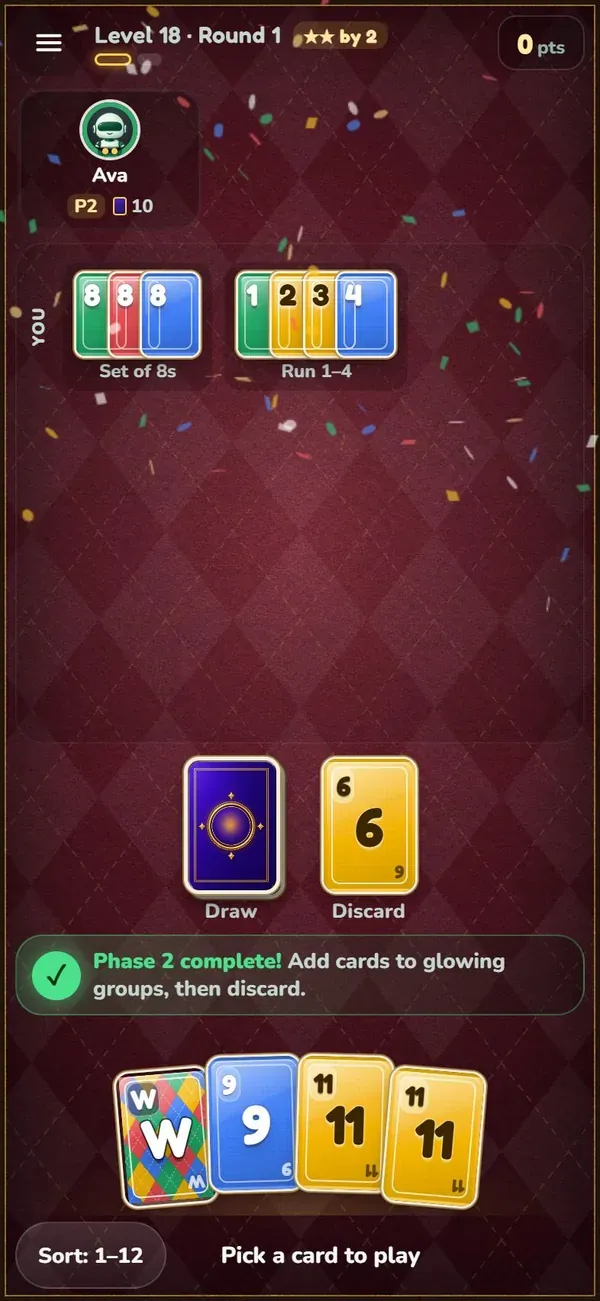
Number Phase is in that last family. Its deck has numbers 1 to 12 in four colors, two of each, plus 12 Wilds and 4 Skips. Sets are matching numbers, runs are numbers in order, and one phase asks for cards of a single color. The game shows exactly what each phase needs, and the how to play guide explains every step of a turn.
Which is easier: a set or a run?
This is the question that matters at the table, and the honest answer is “count your outs.” An out is any unseen card that improves your group. More outs means a better chance the next draw helps.
Outs for a set
Say you hold a pair of 7s in a standard 52-card deck. There are four 7s in total, and you have two, so only two cards finish the set.
In Number Phase the numbers are deeper. Each number appears eight times (four colors, two copies each). Hold two 7s and there are six more 7s in the deck, plus 12 Wilds that can stand in. That’s up to 18 cards that complete the set, before you subtract anything already in other hands or the discard pile.
Outs for a run
Now hold 5-6 of hearts in a standard deck. The 4 of hearts or the 7 of hearts would make a three-card run. That’s two outs, the same as the pair, but there’s a bonus: once the run exists, it can keep growing from either end.
A gap is worse. Holding 5 and 7 of hearts, only the 6 of hearts fills it. One out.
In Number Phase the picture shifts again. Every number has eight copies, so each spot in a run has more cards that might fill it, and any of the 12 Wilds can stand in for a missing number. Open-ended runs end up with plenty of outs.
The pattern
- Pairs have a fixed number of outs: the remaining cards of that rank.
- Open-ended run pieces (two connected cards in the middle of the range) can be finished from two directions.
- Gapped runs (5 and 7) and edge runs (1-2, or 11-12 in a 1-to-12 deck) can only be finished one way.
- Wilds add outs to everything, which is why they’re so precious.
Key takeaway: don’t ask “set or run?” Ask “how many cards help this?” and keep the groups with the most outs.
Long runs are a different beast
A three-card run and a seven-card run are not the same problem. A run of seven needs seven different numbers in a row, and every missing number is its own small hunt.
Here’s a way to think about it. With 3-4-5-6 in hand and a run of seven to make, you still need three more numbers. They could be 1-2 (plus a 7), or 7-8-9, or 2 and 7 and 8, and so on. You have several possible finishes, which is good, but each draw only helps if it lands on one of the numbers your current shape can use.
Long runs reward patience and Wilds. Duplicates hurt them: a second 5 does nothing for a run, so it’s usually the first card to let go.
How to decide which cards to keep
Every rummy turn ends with a discard, and that’s where sets-and-runs thinking pays off. Some habits that hold up across the family:
- Keep cards that serve two groups. A 6 that sits next to your 5-7 and also pairs with another 6 has two jobs. Cards with two jobs are the last to go.
- Break the group with the fewest outs. If you must split something, give up the gapped run or the pair whose matching cards you’ve already seen discarded.
- Watch the discard pile. Cards that have been thrown away aren’t coming back. If two of the 9s you need are in the discard pile, your 9s set just got harder.
- Watch what opponents pick up. Anyone taking from the discard pile is telling you what they’re building. Avoid handing them the next piece.
- Spend Wilds on the hardest gap. In games with Wilds, a Wild in a long run usually saves more draws than a Wild in a set.
Sets and runs in a phase-based game
Phase-based rummy adds one twist: the shape you need changes from round to round. A hand that’s perfect for two sets of three might be useless for a run of seven.
That makes flexibility even more valuable. Early in a round, keep cards that could serve your current phase two different ways. Once one plan is clearly ahead, commit and discard the rest.
It also means you’ll learn sets and runs fast. A single game of Number Phase walks you through sets, runs and a color phase, and the hint system tells you when you’re one card away, which is a nice way to build an eye for outs. When you’re ready for more, our Number Phase strategy tips put these ideas to work.
Try it yourself
Reading about outs is one thing. Watching a pair of 4s turn into a set because you held on one turn longer is another. Open a free game in your browser, play a quick five-phase match, and count your outs before every discard. If you’d like to try the wider rummy family first, start with our look at free rummy games online.
FAQ
What is the difference between a set and a run in rummy?
A set is cards of the same rank or number, like three 7s. A run is cards in sequence, like 4-5-6. In a standard 52-card deck, a run also has to be in one suit, while a set uses different suits.
How many cards do you need for a set or a run?
In most rummy games the minimum is three. Contract and phase-based games set their own sizes, asking for things like a set of four or a run of seven.
Is a set or a run easier to complete?
It depends on how many cards can finish it, which players call outs. A pair waiting on a set needs one specific rank, while an open-ended run can be finished from either end, so short runs often have more outs than you’d expect.
Can a card be in a set and a run at the same time?
Not once it’s laid down. A card belongs to one group on the table. While it’s still in your hand, though, a card that could go either way is valuable because it keeps your options open.