How to Play Number Phase: Rules, Phases and Scoring
Number Phase how to play guide: the ten phases, every step of a turn, Wilds and Skips, penalty points, and which mode to start with. Free in your browser.
Want the quick version of Number Phase how to play? Each round you draw, try to lay down your current phase (like two sets of three, or a run of seven), add cards to groups on the table, then discard. Empty your hand first to end the round. Clear all ten phases and finish with the lowest score to win.
That’s the whole loop. The rest of this guide walks through each part in order: the deck, a turn, what the phases ask for, how scoring works, and which mode to pick first. By the end you’ll be ready to sit down at a table against the bots or pass the phone around at game night.
Number Phase is a rummy-style card game that runs in your browser on a phone or a computer. You don’t need to download anything or make an account to start.
The goal: climb ten phases
A phase is a goal for your hand. Early on it might be two sets of three. Later you’ll see longer runs, and one phase asks for cards of a single color. There are ten phases in all, and the tenth is always shown as the Final Phase.
Everyone works on their own phase. If you lay yours down during a round, you move up one phase for the next round. If you don’t, you stay on the same phase and try again. So two players at the same table can be several phases apart, and the leader can change quickly.
The game ends after the Final Phase. In the game’s own words: finish the Final Phase with the lowest score to win.
Key takeaway: you only need to complete one phase per round, but every card left in your hand at the end of a round costs you points.
What’s in the deck
Number Phase uses its own 112-card deck:
- Number cards 1 to 12 in four colors, two of each.
- 12 Wild cards.
- 4 Skip cards.
The extra Wilds are on purpose. Our testing showed they cut down on long stretches of drawing and discarding with nothing happening, without making the game any less skillful.
The building blocks: sets, runs and color
Every phase is made from three kinds of groups. If you’ve played other rummy games, the first two will feel familiar.
Sets
A set is a group of cards with the same number. A set of three could be three 7s. The colors don’t need to match.
Runs
A run is numbers in order, like 3-4-5-6-7. A run of seven needs seven numbers in a row. Since the deck goes from 1 to 12, a run of seven can start anywhere from 1 to 6.
Color groups
One phase asks for cards that all share a color. The numbers don’t matter here, only the color.
Wilds in groups
A Wild can stand in for a card in any group. If you have 5-6-Wild-8, the Wild plays the 7. By default a group can even be made entirely of Wilds. In a custom game you can switch on “Every group needs a number card” if your table prefers the stricter rule.
For a deeper look at how sets and runs work across the whole rummy family, read our guide to sets vs. runs.
How a turn works
Every turn follows the same four steps.
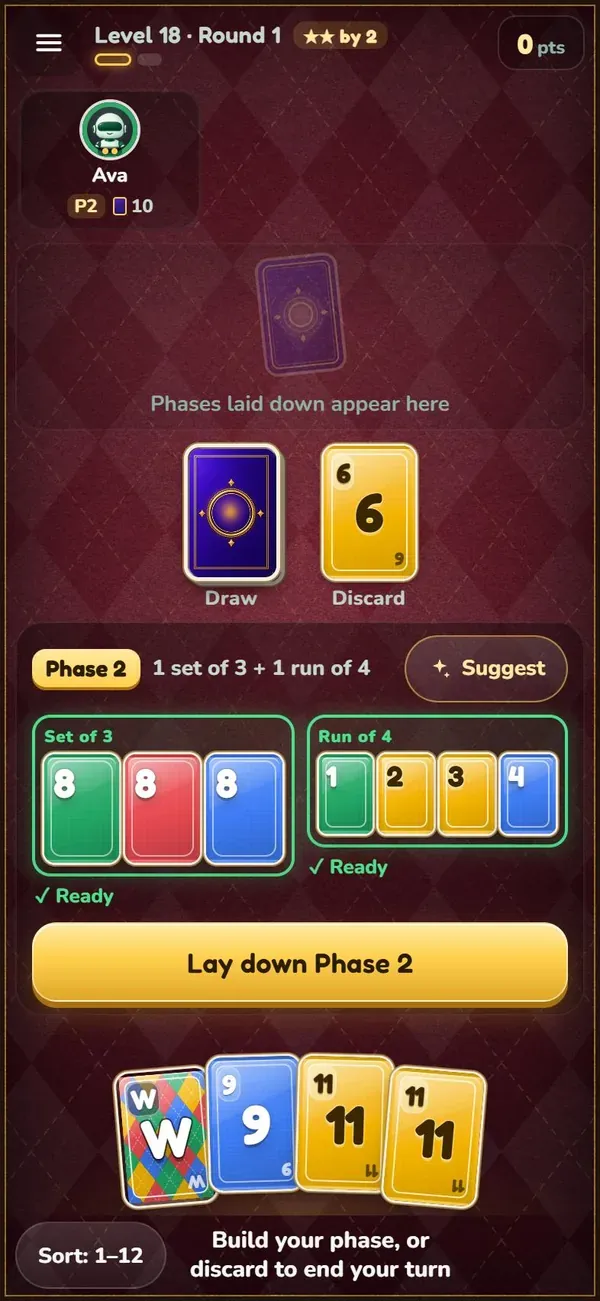
- Draw a card. Take the top card of the draw pile, or take the top card of the discard pile if it helps you.
- Lay down your phase, if you can. You need every group in the phase at once. You can’t lay down half a phase.
- Add cards to groups on the table. These extra plays are often called hits. They let you get rid of cards that fit groups already laid down.
- Discard one card. This ends your turn.
When one player empties their hand, the round ends right away. Everyone else counts the cards still in their hands as penalty points, and a new round is dealt.
There’s one rare edge case worth knowing. If the draw pile and the discard pile both run out, drawing from the deck simply gives you no card, and play carries on. The game never stalls.
Skips
When you discard a Skip, another player loses their next turn. Skips stack, so if two Skips land on the same player, they miss two turns. Holding a Skip until the leader is close to going out can swing a round.
Laying down: drag, tap or Suggest
The controls are built for one hand on a phone, and they work with a mouse too.
- Drag cards into the slots for your phase.
- Tap to place: select cards, then tap a slot, a glowing group, or the discard pile. Every drag has a tap version.
- Suggest: tap it and the game fills your phase for you if your hand can make it.
- Lay Down: once the slots are full, one tap puts your phase on the table.
The game also helps you read your own hand. Slots glow when a group is ready, and a hint tells you when you’re one card away from your phase. Those hints are worth watching, because they tell you which discard to pick up.
Scoring and penalty points
Number Phase scores like golf: lower is better.
At the end of each round, every card left in a player’s hand counts as penalty points against them. The player who went out adds nothing that round. Over a full game, those points pile up, and the final standings come down to who finished the Final Phase with the lowest total.
The in-game Rules screen lists exactly what each card is worth, so check it before your first full match. The general lesson holds for any card value: the fewer cards you’re holding when someone goes out, the less it hurts.
Ties
If players tie at the end, the tied players replay the Final Phase by default. A custom game can switch this to a shared win instead.
Game modes
Number Phase has four ways to play. Here’s how they compare.
| Mode | Who you play | How long |
|---|---|---|
| Campaign | Robot rivals, table by table | A few minutes per level |
| Quick game | Bots, five phases | About eight minutes |
| Custom game | Up to five bots, all ten phases | 20 to 30 minutes |
| Pass-and-play | Two to six people on one phone | Depends on your table |
Campaign
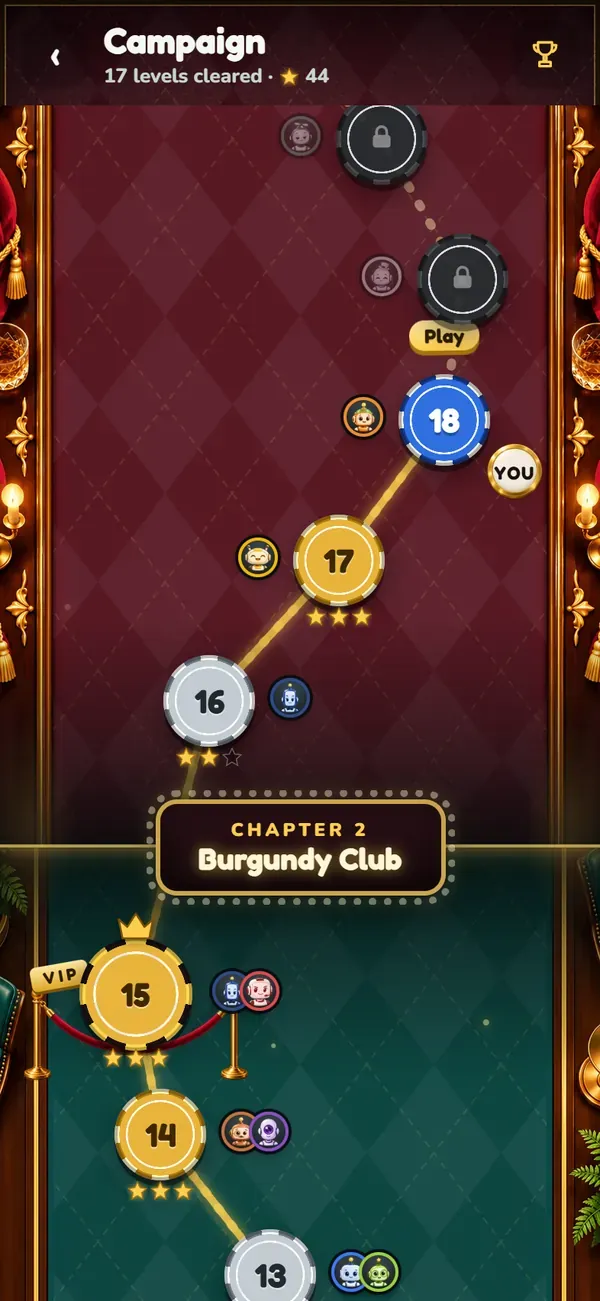
The campaign is an endless road of tables, each with its own phases and rivals. You earn up to three stars per level and face a boss every 15th level. Wins also unlock felts and card backs for your table. It’s the best place to learn, since the early levels are gentle warm-ups.
Quick game
A five-phase game against bots. It’s the right pick when you have a coffee break, not an evening.
Custom game against bots
The full ten-phase match against up to five bots. You set the table: how many rivals, how hard they play (Easy, Normal or Hard) and house rules like the Wild rule above.
Pass-and-play
Two to six people share one phone. A hand-off screen hides each hand between turns, so nobody sees what they shouldn’t. It’s built for game night, and we cover it in more depth in our pass-and-play guide.
Your first game, step by step
If you’ve never played, here’s a simple path.
- Open Number Phase in your browser. No account is needed.
- Start the campaign. The first levels are warm-ups.
- Before your first draw, read your phase. Know exactly which groups you need.
- Sort your hand mentally into “helps my phase” and “doesn’t”. Discard from the second pile.
- Watch for the one-card-away hint, and grab that card from the discard pile when it shows up.
- Lay down as soon as you can, then use hits to empty your hand.
- Lost a level? Read the coaching tip on the results screen. It points at what to try next.
Achievements and rewards
There are 24 achievements to unlock. They earn new felts and card backs, so your table can look the way you like. Campaign stars do the same job: they mark your progress down the road of tables.
On iPhone, you can add Number Phase to your Home Screen to open it full-screen like an app.
Common rules questions
Can I lay down part of my phase? No. You need every group at once.
Can I add to other players’ groups? You can add cards to groups on the table, which is how you shed cards after laying down.
What happens if I miss my phase? You stay on it and try again next round, with a fresh hand.
Do I keep cards between rounds? No. Every round is dealt fresh.
Can I stop in the middle of a game? Local games save as you play, so you can close the tab and pick up where you left off with Resume.
Does it work on desktop? Yes. Everything that works with a finger works with a mouse, including drag and the tap-to-place controls.
Ready to play?
The fastest way to learn is one campaign level. Read your phase, draw, lay down, hit, discard, and you’ve got it. When you want to get sharper, our Number Phase strategy tips cover discards, timing and keeping your penalty points low, and how to beat the bots covers the robot rivals.
Play Number Phase now, free in your browser.
FAQ
How many phases are in Number Phase?
There are ten. Each round you try to lay down your current phase. Make it and you move up to the next one; miss it and you try the same phase again next round. The tenth is called the Final Phase.
How do you win Number Phase?
Finish the Final Phase with the lowest score. Your score is the penalty points from cards left in your hand at the end of each round. If players tie, the tied players replay the Final Phase by default.
What do Wild and Skip cards do?
A Wild stands in for a number card in any group you lay down. A Skip makes another player miss a turn, and Skips stack, so a player can be skipped more than once before their turn comes around.
Can I play Number Phase with friends?
Yes. Pass-and-play lets two to six people share one phone, with a hand-off screen that hides each hand between turns. Online play isn’t available yet.
Is Number Phase free?
Yes. It’s free to play in your browser on phone or desktop, with no ads, no purchases and no energy timers, and you don’t need an account to start.