Double Bust Scoring: How Chips × Mult Works
Double Bust scoring explained with worked examples: hand types, the Mult ladder, Stand Pat, doubles and dealer outcomes, plus how to plan each Bounty.
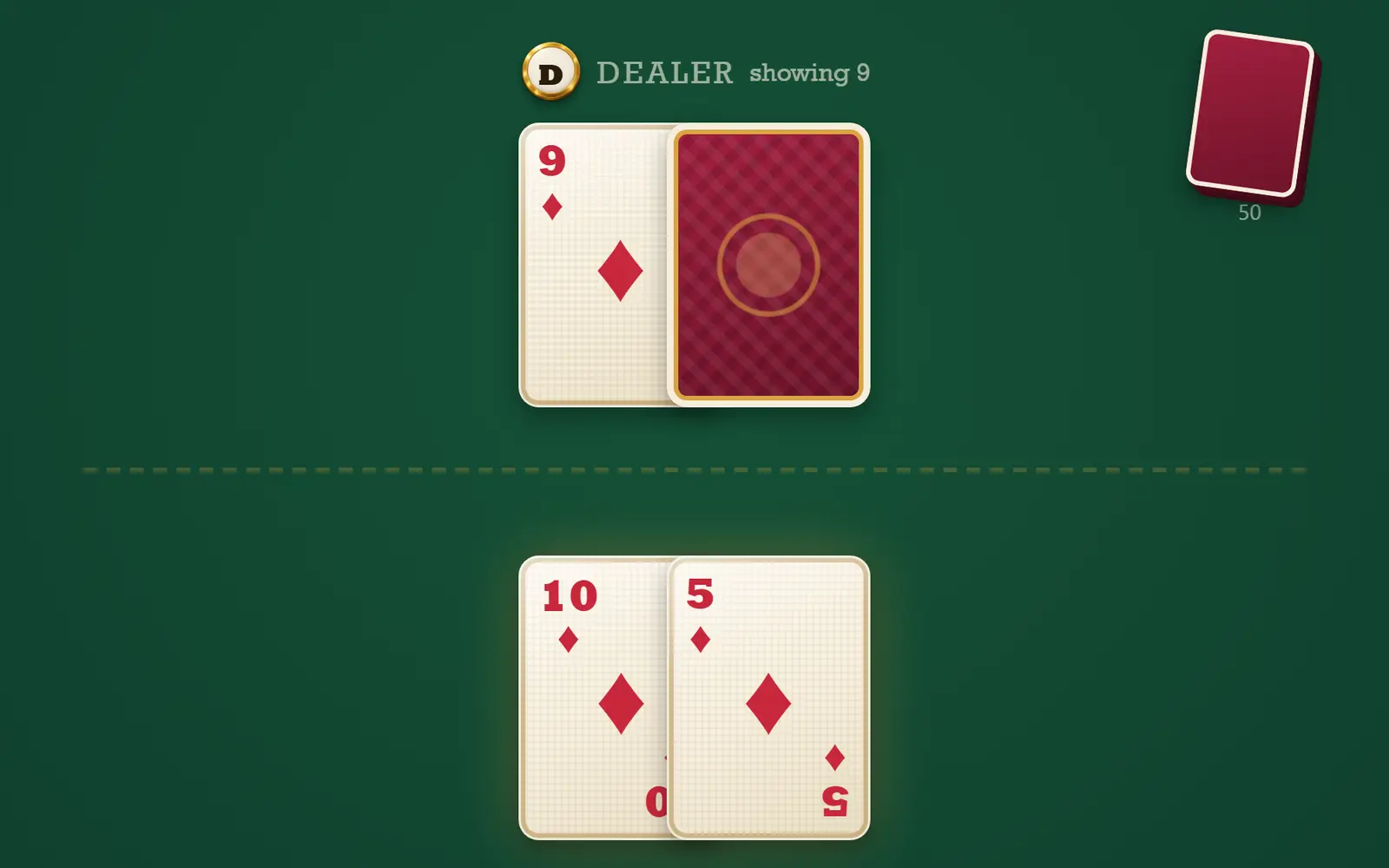
Double Bust scoring comes down to one line: Chips × Mult × the dealer outcome. Your hand type sets the base Chips and Mult, your cards add Chips, your Grifts add or multiply on top, and then beating the dealer (or not) scales the result. Learn the numbers once and you can plan every table.
This guide breaks down each step with worked examples you can check yourself, then shows how to plan for the Bounty on each Floor. If you haven’t played yet, the how to play guide covers the rules of Double Bust from the start.
The scoring order
Every finished hand is scored in the same order:
- The hand type sets base Chips and Mult.
- Each card adds its Chips, left to right, plus any enhancement (Foil +20 Chips, Holographic +4 Mult, Polychrome ×1.5 Mult, Gold +$2).
- Grifts apply, left to right in slot order.
- Chips × Mult gives the hand score.
- A doubled hand applies its double result instead of the normal outcome.
- The dealer outcome multiplies it.
- The result rounds down and goes onto your Table Score.
Card Chips
- 2 to 10 add their number.
- J, Q and K add 10.
- An Ace adds 11, or 1 if it’s counting as 1 to keep you under 21.
Hand types
| Hand type | Base Chips | Mult |
|---|---|---|
| Stand (20 or less) | 10 + card Chips | 1× at 12 or less, rising 0.25 per point: 16 = 2×, 18 = 2.5×, 20 = 3× |
| Twenty-One (21 with 3+ cards) | 30 + card Chips | 4× |
| Natural Blackjack (21 on the deal) | 40 + card Chips | 5× |
| 5-Card Charlie (5 cards, no bust) | 50 + card Chips | 5× |
| Bust | 0 |
Dealer outcomes
| Result | Outcome |
|---|---|
| Beat the dealer, or the dealer busts | ×1.5 |
| Stand Pat: stood on your first two cards and the dealer busts | ×3 |
| Push | ×1 |
| Dealer wins | ×0.5 |
| Doubled hand wins / pushes / loses | ×2.5 / ×1 / 0 |
Key takeaway: a loss still scores half, a bust scores nothing. Avoiding busts is worth more than chasing perfect totals.
Worked examples (no Grifts)
A two-card 16
You stand on 10 and 6. Chips: 10 + 16 = 26. Mult at 16: 2×. Hand score: 52.
- Dealer wins: 52 × 0.5 = 26
- You beat the dealer: 52 × 1.5 = 78
- Dealer busts (Stand Pat): 52 × 3 = 156
That last line is why a two-card 16 against a weak upcard is worth standing on.
A Twenty-One
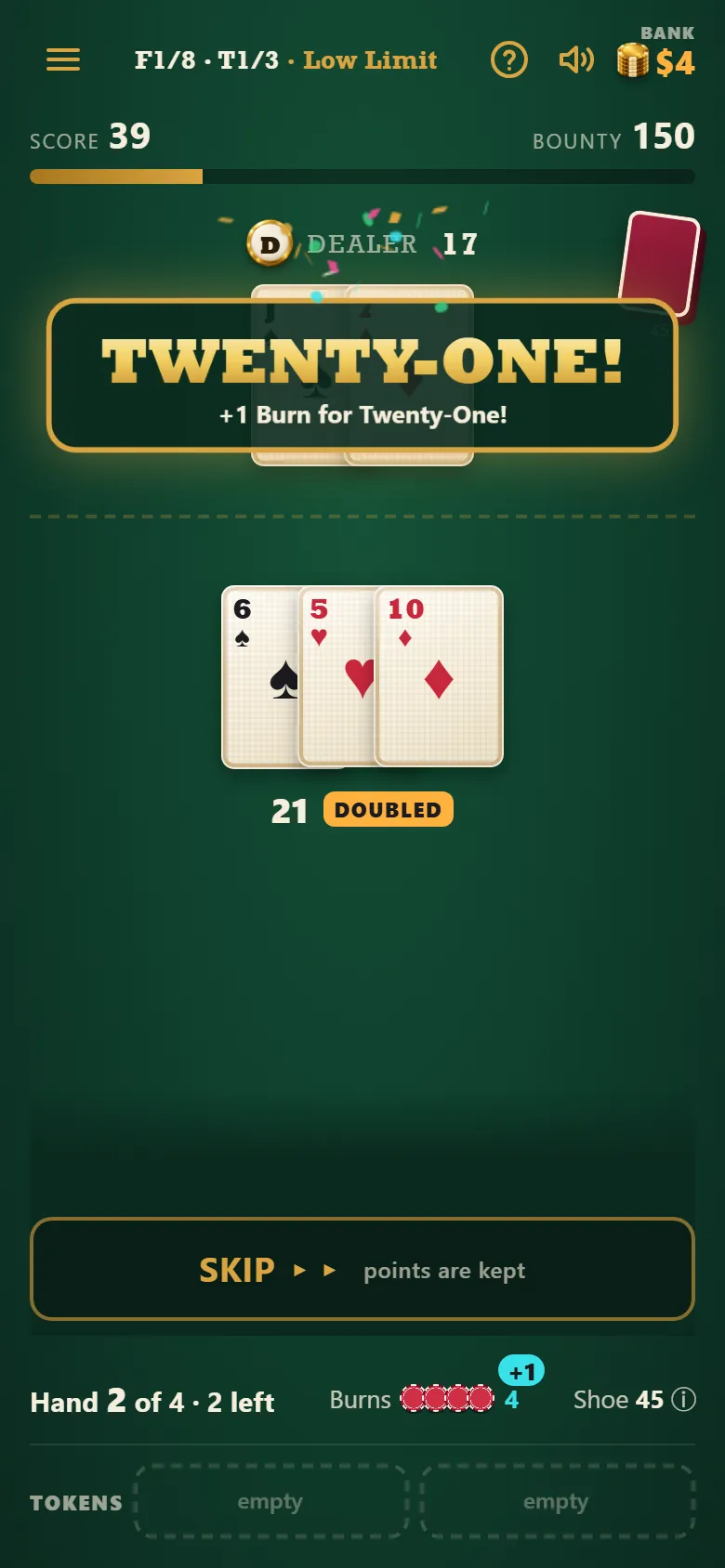
You hit 5 and 6, draw a 10, and land on 21 with three cards. Chips: 30 + 21 = 51. Mult: 4×. Hand score: 204. Beat the dealer for 306, or push against a dealer 21 for 204. You also get +1 Burn for the table.
A doubled 11
You double on 6 and 5 and draw a King: 21 with three cards, so it’s a Twenty-One. Hand score 204, and a won double is ×2.5: 510. If the dealer beats you, the hand scores 0. A hard 11 can’t bust on one card, so you can’t Double Bust here. Doubling a 12 or higher risks the bust that costs you a Hand.
A Natural Blackjack
Ace and King on the deal. Chips: 40 + 11 + 10 = 61. Mult: 5×. Hand score: 305. Beat the dealer: 457.5, rounded down to 457. You also get +$2. It only pushes against a dealer Blackjack.
A 5-Card Charlie
2, 3, 4, 2 and 5: five cards totaling 16. Chips: 50 + 16 = 66. Mult: 5×. Hand score: 330. A Charlie always counts as a win against the dealer, so ×1.5 = 495. It also ignores boss rules for that hand.
Adding Grifts
Grifts change the numbers in step 3. Take the two-card 16 above and add Penny Slots (+8 Chips) and Low Roller (+20 Chips when standing on 13 to 17). Chips become 26 + 8 + 20 = 54. Mult stays 2×, so the hand score is 108, more than double. With Stand Pat, that’s 324 from one hand.
Order matters for Grifts that multiply. Put additive Grifts first and multipliers like High Roller Suite (×2 Mult on 20 or 21) last. Our Grifts guide has a full example of the difference.
Planning for the Bounty
Every table has a Bounty, and you get 4 Hands to reach it. The table ends the instant your score hits the Bounty, and each unused Hand adds $1 for the Back Room.
Here are the Bounties for the first four Floors as currently tuned (Low Limit / High Roller / Pit Boss):
| Floor | Bounties | Per hand, over 4 Hands |
|---|---|---|
| 1 | 150 / 250 / 375 | about 38 / 63 / 94 |
| 2 | 550 / 880 / 1,265 | about 138 / 220 / 316 |
| 3 | 1,150 / 1,450 / 1,750 | about 288 / 363 / 438 |
| 4 | 2,050 / 2,585 / 3,115 | about 513 / 646 / 779 |
The curve keeps climbing toward Floor 8, and we tune the numbers between updates, so check the table screen for the live target.
Floor by floor
Floor 1: a stand on 18 that beats the dealer scores 105, so the Low Limit table is reachable with no Grifts. Use it to buy your first one or two.
Floor 2: the needed score per hand more than triples. You need two or three Grifts working together by now, and Stand Pat hands start to matter.
Floor 3 and beyond: all 5 Grift slots should be full, in the right order. This is where Packs and card enhancements earn their place, since your shoe is your deck and every Foil or Polychrome card adds up.
Boss adjustments
- The Short Stack gives you 3 Hands instead of 4, but its Bounty is 25% lower.
- The High Roller Syndicate raises the Bounty by 10% of its starting value after each hand, so front-load your best hands.
- Loan Shark Contract, if you take it, raises every Bounty by 15% while you hold it.
Money planning
Table rewards are $4, $5 and $6 for Low, High and Boss. You also earn $1 for every $5 you’re holding when a table ends, up to $5. Holding $25 between shops maxes that out, which can be worth more over a run than an early, weak purchase.
Run the numbers yourself
Once you know the ladder, every hand turns into a quick sum: what do I score if I stand, and what if I hit? Play Double Bust free in your browser and try it on a Floor 1 table. It’s a card game with no real money, only Chips, Mult and a Bounty to beat.
FAQ
How is a hand scored in Double Bust?
The hand type sets base Chips and Mult, your cards add their Chips, your Grifts apply left to right, and then Chips × Mult is multiplied by the dealer outcome. The result is rounded down and added to your Table Score.
Do you still score if you lose to the dealer?
Yes. A hand that loses to the dealer scores half (×0.5). Only a bust scores 0, unless a Grift or Cheat Token rescues it.
What is Stand Pat in Double Bust?
If you stand on your first two cards (no hit, no double, not a split hand) and the dealer busts, the outcome multiplier is ×3 instead of ×1.5.
What is a good score per hand in Double Bust?
It depends on the Floor. Floor 1’s first table needs 150 across 4 Hands, under 40 per hand, while later Bounties need hundreds per hand, which is why Grifts and card enhancements matter.