How to Play Double Bust: The Blackjack Card Roguelite
Double Bust how to play: hit, stand, double and split against the dealer, score Chips × Mult, beat each table's Bounty and build your deck in the Back Room.
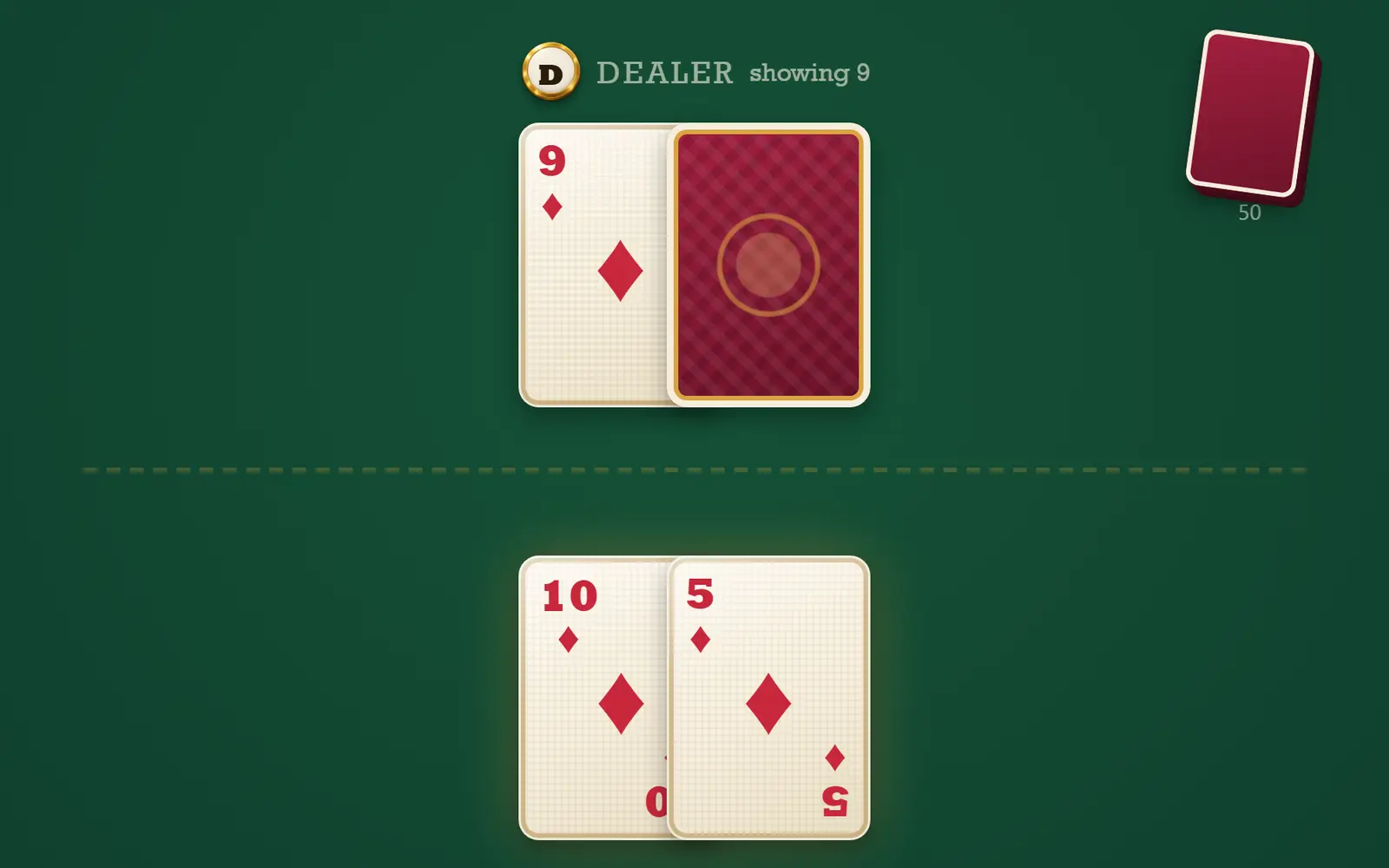
Here’s Double Bust how to play in one breath: every hand, you hit, stand, double down or split against the dealer’s upcard, the way you would in blackjack. Your finished hand scores Chips × Mult, and beating the dealer multiplies it. Reach each table’s Bounty within 4 Hands to move on, spend your winnings on Grifts in the Back Room, and clear 8 Floors to win the run.
Double Bust is a blackjack card roguelite that runs free in your browser on phone or desktop. It’s a card game with no real money: the chips and dollars only exist inside the game, and nothing is bought, staked or won for real.
This guide walks through a run from the top: the structure, the four decisions, scoring, the Back Room and the Pit Bosses.
The shape of a run
A run is 8 Floors. Each Floor has three tables, played in order:
- Low Limit: the gentlest Bounty on the Floor.
- High Roller: a bigger Bounty.
- Pit Boss: the biggest Bounty, plus a boss rule that bends the game.
Each table has a Bounty, a target score. Clear it and you head to the Back Room to shop, then on to the next table. Fall short and the run is over. Floor 8 ends with The House, the final boss. Beat it and you’ve won.
A table takes about 2 minutes, and a winning run takes about 25 to 40.
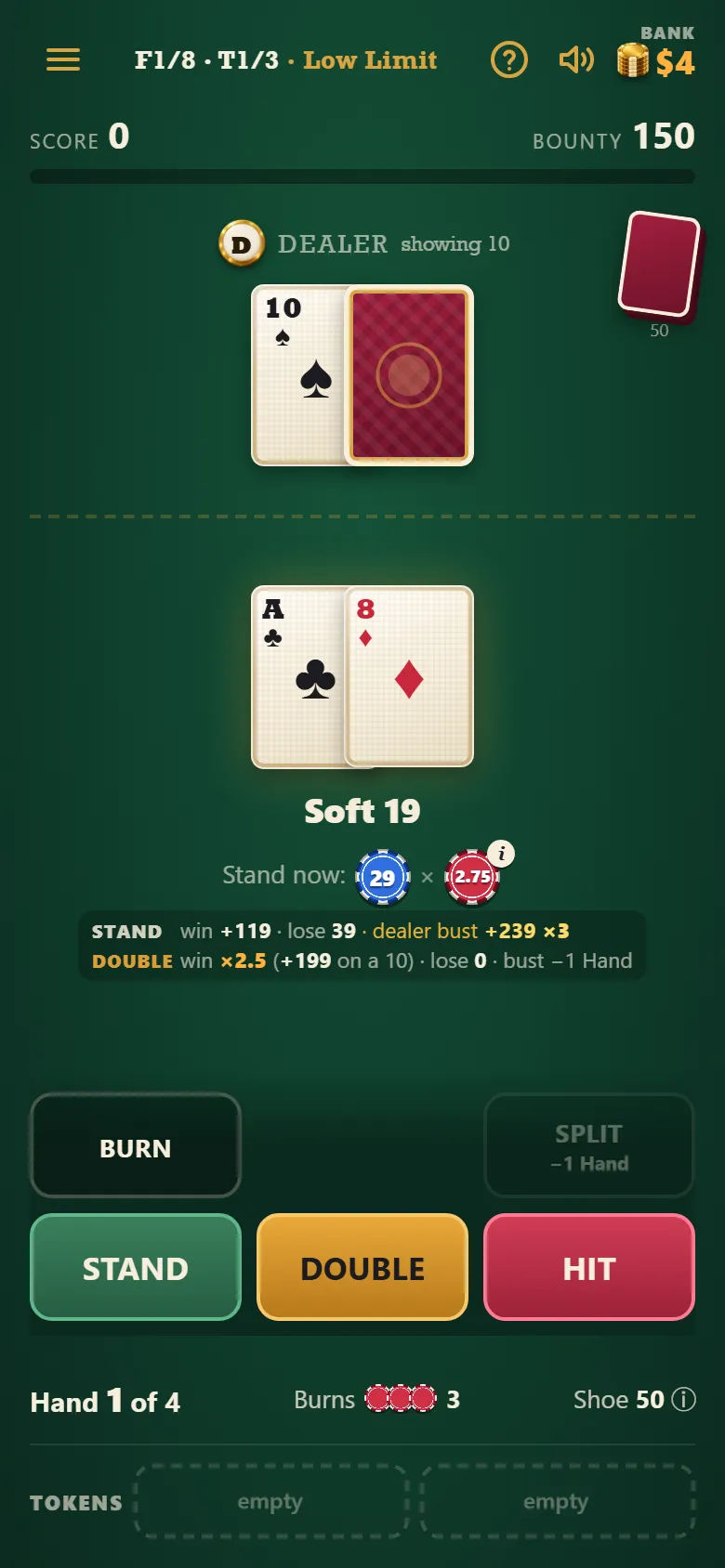
Your resources at each table
Every table gives you the same budget:
- 4 Hands. Each two-card deal uses one Hand. The Hand is your real limited resource.
- 3 Burns. Before your first action on a hand, you can spend a Burn to throw away one or two of your opening cards and draw replacements. Once you hit, double or split, Burns are off the table for that hand.
The table ends the moment your Table Score reaches the Bounty. Any Hands you didn’t need are worth extra money for the Back Room, so finishing early pays off.
Key takeaway: you’re not trying to win hands. You’re trying to reach a score with four Hands, and every decision should serve that.
The dealer
Every hand is played against a dealer. Here’s how the dealer works:
- The dealer shows one upcard when you’re dealt in. The hole card is revealed after you finish.
- The dealer hits until 17 and stands on all 17s (some Pit Bosses change this).
- The dealer draws from a separate standard 52-card House Shoe that’s reshuffled every table. Your deck changes never help or hurt the dealer.
The upcard is the most important piece of information you get. A dealer showing a 5 or 6 is more likely to bust. A dealer showing a 10 or an Ace usually makes a strong hand. If you’d like a refresher on reading the upcard, our guide to hit, stand, double and split covers it.
Card values
Your cards work like standard blackjack, and each one also adds Chips:
- 2 to 10: their number, in total and in Chips.
- J, Q, K: 10.
- Ace: 11 (and 11 Chips) unless that would bust you, in which case it’s 1 (and 1 Chip). Each Ace adjusts on its own.
Your four decisions (plus Burn)
Hit
Take another card. Hit as often as you like, but go over 21 and you bust, which scores 0.
Stand
Keep your hand. Standing scores better the higher your total: a stand’s Mult climbs from 1× at 12 or less to 2× at 16, 2.5× at 18 and 3× at 20.
Double down
Allowed on any two-card hand (not on split hands). You draw exactly one card and stand automatically. A double is all-or-nothing on the outcome:
- Win: ×2.5 instead of the usual ×1.5.
- Push: ×1.
- Lose: the hand scores 0.
And if a doubled hand goes over 21, that’s a Double Bust: it scores 0 and also costs you one of your remaining Hands at that table. Yes, that’s where the game gets its name.
Split
If your two opening cards share a rank, you can split them into two hands by spending one extra Hand. Each new hand gets one drawn card and plays on its own against the same dealer hand. You can split once per hand (no re-splitting). Split Aces get one card each and stand automatically. You can’t split with 0 Hands left.
Burn
Not a blackjack move, but a handy one. Before acting on a hand, spend a Burn to swap out one or two opening cards. A Burn can turn a stiff 13 into something worth playing.
Scoring: Chips × Mult
When a hand finishes, it’s scored in a fixed order:
- The hand type sets your base Chips and Mult.
- Your cards add their Chips left to right, along with any card enhancements.
- Your Grifts apply, left to right in their slot order.
- Chips × Mult gives the hand score.
- The dealer outcome multiplies it.
Here are the hand types:
| Hand type | When | Base Chips | Mult |
|---|---|---|---|
| Stand | Stand on 20 or less | 10 + card Chips | 1× to 3×, rising with your total |
| Twenty-One | Exactly 21 with 3+ cards | 30 + card Chips | 4× |
| Natural Blackjack | 21 on the two-card deal | 40 + card Chips | 5× |
| 5-Card Charlie | 5 cards without busting | 50 + card Chips | 5× |
| Bust | Over 21 | Scores 0 |
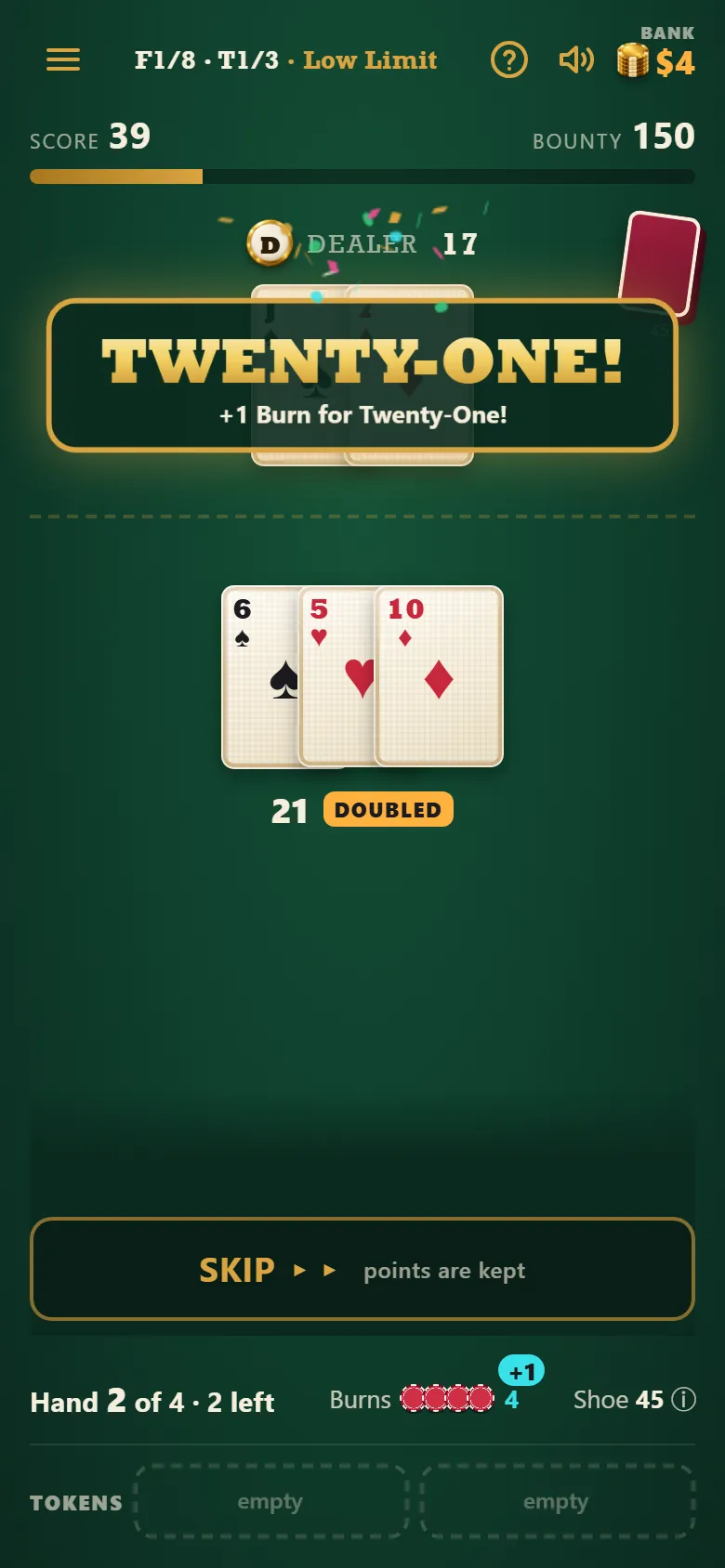
A few extras: a Twenty-One stands automatically and gives you +1 Burn for the table. A Natural Blackjack earns +$2 and only pushes against a dealer Blackjack. A 5-Card Charlie stands automatically, always counts as a win against the dealer, and ignores boss rules for that hand.
The dealer outcome
| Result | Outcome |
|---|---|
| You beat the dealer, or the dealer busts | ×1.5 |
| Stand Pat: you stood on your first two cards and the dealer busts | ×3 |
| Push | ×1 |
| The dealer beats you | ×0.5 |
Losing still scores half. That’s important: a hand that loses to the dealer isn’t wasted, it just counts for less.
A quick example
You’re dealt a 10 and an 8 and stand on 18. Chips are 10 base plus 18 from your cards, so 28. Mult for 18 is 2.5×. That’s 70.
- Beat the dealer: 70 × 1.5 = 105.
- Dealer busts: you stood on your first two cards, so it’s Stand Pat, 70 × 3 = 210.
- Dealer beats you: 70 × 0.5 = 35.
Our Chips × Mult scoring guide has more worked examples and how to plan for each Bounty.
The Back Room
After every table you clear, you visit the Back Room, the game’s shop. Money comes from table rewards, unused Hands, interest on what you’ve saved, and Natural Blackjacks. Inside you’ll find:
- Grifts: passive perks that change how hands score. You have 5 Grift slots. Each shop offers 3 Grifts you don’t own, and at least one is Uncommon or Rare when one is available. You can drag Grifts to reorder them, and order matters.
- Cheat Tokens: one-shot items you can use mid-hand, like Peek (see your next 3 cards), Weighted Die (your next card is a 10-value card) or Croupier’s Distraction (undo a bust). You hold up to 2.
- Packs: add a card to your deck, enhance a card, grab a Cheat Token, or (from Floor 3) pick a Rare or better Grift.
- Rerolls: the first reroll in each shop costs $1, then the price climbs.
You can also sell a Grift for half its cost.
Your shoe is your deck
Your shoe starts as a standard 52 cards, and it’s yours for the whole run. Cards you add, remove or enhance stay with you. Enhancements include Foil (+20 Chips), Holographic (+4 Mult), Polychrome (×1.5 Mult), Gold (+$2) and Marked (shown face-up when it’s next in your shoe).
The Grifts guide covers the Grifts and how to combine them.
Pit Bosses
Each Floor ends with a Pit Boss table, and the upcoming boss is shown at the start of the Floor so you can plan. Bosses are drawn by seed and don’t repeat in a run. Floors 1 to 3 draw from bosses like The Bouncer (no doubling) and The Short Stack (3 Hands instead of 4, with a lower Bounty). Floors 4 to 7 bring harder rules, like The Blindfold, which deals your second card face-down until you stand or double.
On Floor 8, The House applies one random rule each hand from the bosses you’ve already beaten that run.
Controls and saving
Tap or click the buttons. On desktop, hotkeys work too: 1 Hit, 2 Stand, 3 Double, 4 Split, B Burn, Q and W for your tokens, and Space to deal or continue.
The game saves in your browser after every action, so you can close the tab and pick up where you left off. Quitting and reloading never rerolls a hand. Clearing your browser data deletes the save.
Start your first run
Open Double Bust, read the dealer’s upcard, and play your first Low Limit table. Stand on strong two-card hands against a weak upcard, double your 10s and 11s, and buy a Grift in the Back Room. You’ll learn the rest by the first Pit Boss. New to the genre? Our explainer on what a roguelite is shows why losing a run is part of the fun.
FAQ
Is there real money in Double Bust?
No. Chips and dollars in Double Bust exist only inside the game. Nothing is bought, staked or won for real. It’s a card game that uses blackjack’s rules as its engine.
How do you win a run of Double Bust?
Clear all 8 Floors. Each Floor has three tables (Low Limit, High Roller and a Pit Boss), and each table has a Bounty you must reach within 4 Hands. Beat The House on Floor 8 to win the run.
What happens if I don’t reach the Bounty?
The run ends. If your Hands run out before your Table Score reaches the Bounty, that’s game over, and you start a fresh run from Floor 1.
How long is a run of Double Bust?
A table takes about 2 minutes. A winning run takes about 25 to 40 minutes, and the game saves after every action, so you can stop between hands.
What is a Burn in Double Bust?
Before your first action on a hand, you can spend a Burn to throw away one or two of your opening cards and draw replacements. You get 3 Burns per table, and they can’t be used after you hit, double or split.