Hit, Stand, Double, Split: Blackjack Decisions Explained
Hit, stand, double, split: what each blackjack decision means, why the dealer's upcard matters, the standard plays, and how Double Bust changes them.
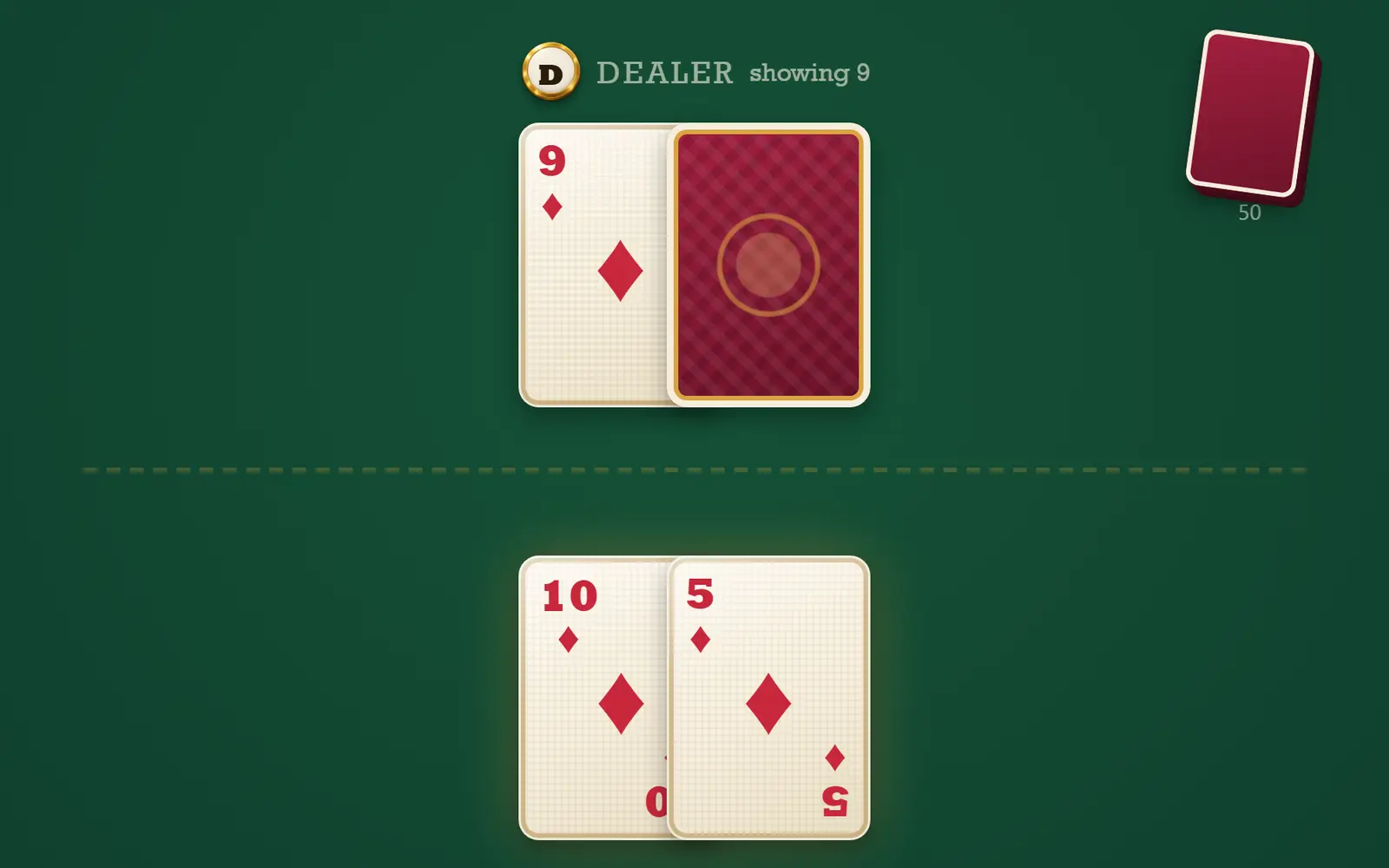
Hit, stand, double, split: those four words are the whole of blackjack’s decision-making. Hit takes another card. Stand keeps what you have. Double takes exactly one more card and stops, with the hand counting double. Split turns a pair into two hands. Which one is right depends on two things: your total, and the one card the dealer shows.
This guide explains each decision, why the dealer’s upcard drives everything, and the standard plays that card players have worked out for each situation. We’ll treat blackjack the way we like it best: as a card game about decisions. Then we’ll show how Double Bust, our blackjack card roguelite, changes some of the math.
The goal and the basics
In blackjack you try to finish with a higher total than the dealer without going over 21. Going over is a bust, and a bust loses right away.
Card values are simple:
- 2 to 10 count as their number.
- Jacks, Queens and Kings count as 10.
- An Ace counts as 11, or as 1 if 11 would bust you.
A hand with an Ace counted as 11 is called soft (soft 17 is Ace-6). Any other hand is hard. A soft hand can’t bust on the next card, because the Ace can drop to 1.
Why the dealer’s upcard matters
The dealer shows one card face-up (the upcard) and keeps one face-down. The dealer has no choices: they must hit until they reach 17, then stand. Some tables have the dealer hit a soft 17; others stand on all 17s.
That fixed rule is the key to the whole game. Because the dealer must keep drawing below 17:
- Showing 2 to 6, the dealer is in a weak spot. They’ll often have to hit a stiff total like 12 to 16, and they bust more often. Showing 5 or 6 is the dealer’s weakest position.
- Showing 7 to Ace, the dealer is likely to end up with a solid total, so a weak hand of yours probably won’t hold.
Key takeaway: against a weak upcard, let the dealer take the risk. Against a strong upcard, you need to improve your own hand.
Hit
Hitting means asking for another card. You can hit as many times as you like until you stand or bust.
When to hit:
- Any hard total of 11 or less. You can’t bust, so another card can only help (if you’re not doubling).
- Hard 12 to 16 against a dealer 7 or higher. You’ll often bust, but standing usually loses more.
- Hard 12 against a dealer 2 or 3. The one exception in the stiff range.
- Soft 17 or less. The Ace keeps you safe from busting.
Stand
Standing means keeping your hand and ending your turn.
When to stand:
- Hard 17 or more. The bust risk is too high to hit.
- Hard 13 to 16 against a dealer 2 to 6. Let the dealer risk the bust.
- Hard 12 against a dealer 4 to 6.
- Soft 19 or more. It’s already strong.
Soft 18 is the tricky one: standard play stands against 2, 7 and 8, and hits against 9, 10 and Ace (and doubles against 3 to 6 where doubling is allowed).
Double down
Doubling means you take exactly one more card, then automatically stand, and the hand counts double. You’re trading the freedom to keep hitting for a bigger result on a hand you expect to win.
Doubling is strongest when one card is likely to give you a great total, especially a 10-value card, since there are so many of them.
Standard doubles:
| Your hand | Double against |
|---|---|
| Hard 11 | Almost every upcard |
| Hard 10 | 2 through 9 |
| Hard 9 | 3 through 6 |
| Soft 13 to 18 | Weak upcards: 5 or 6 for soft 13-14, widening to 3 through 6 for soft 17-18 |
Split
If your first two cards are a pair, you can split them into two separate hands. Each gets a new second card and plays on its own against the dealer.
The two splits everyone remembers:
- Always split Aces. Two hands starting at 11 beat one soft 12.
- Always split 8s. A pair of 8s is a hard 16, the worst total in the game. Two hands starting at 8 are much better.
And the two never-splits:
- Never split 10s. A 20 is already one of the best hands you can have.
- Never split 5s. A pair of 5s is a hard 10, a great doubling hand.
The rest depend on the upcard: 2s, 3s, 6s and 7s are generally split against a weak dealer card, and 9s are split against most upcards except 7, 10 and Ace (a 7 means your 18 already beats the dealer’s likely 17).
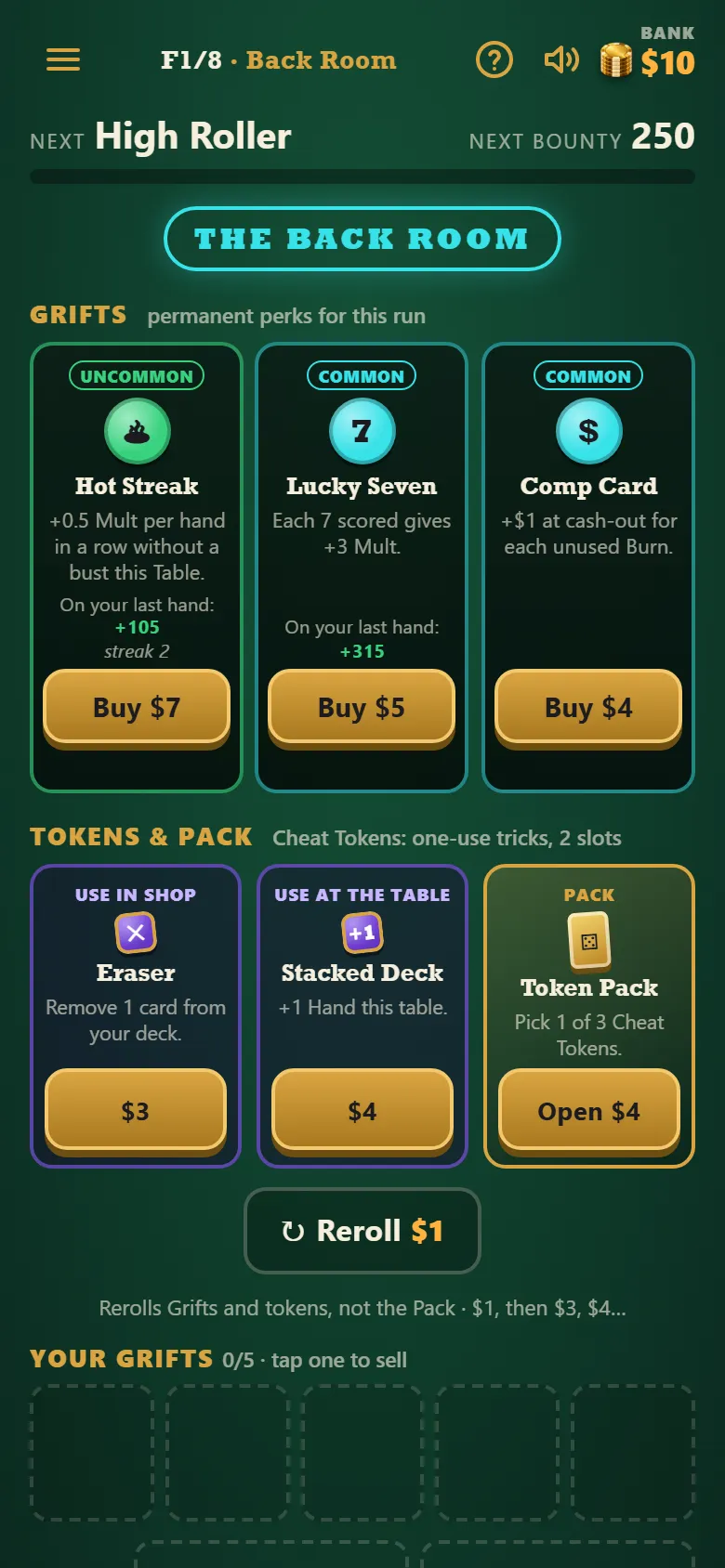
How Double Bust changes the decisions
Double Bust plays every hand against a dealer upcard with familiar rules: the dealer draws from a separate standard 52-card House Shoe, hits until 17 and stands on all 17s. But instead of winning or losing a hand, you’re scoring it, and the scoring changes some classic plays.
Higher stands score more
In Double Bust, a stand’s Mult rises with your total: 1× at 12 or less, 2× at 16, 2.5× at 18, 3× at 20. So there’s a reason to push a stiff hand up toward 17 that doesn’t exist in the classic game.
Losing still scores
A hand that loses to the dealer scores half (×0.5). Beating the dealer, or the dealer busting, scores ×1.5. A push is ×1.
Stand Pat
Stand on your first two cards and the dealer busts, and the outcome is ×3 instead of ×1.5. This keeps the upcard central. The game’s own testing found that with no Grifts, a two-card 16 should stand, and a 15 stands only against 2 to 6. With Grifts, 14 also stands against 2 to 6 and 13 against 3 to 6. A hard 12, and any hand of three or more cards, hits to 17.
Doubles are all-or-nothing
A doubled hand that wins scores ×2.5, a push ×1, and a loss scores 0. If a doubled hand busts, that’s a Double Bust: 0 points and one fewer Hand at that table. Under these rules the strong doubles are 11 against anything and 10 against 2 to 10. With a couple of Grifts, doubling 9 against 2 to 8 joins them. You can double any two-card hand, but not split hands.
Splits cost a Hand
You get 4 Hands per table, and splitting spends an extra one. You can split once per hand (no re-splitting), and split Aces get one card each and stand.
Moves blackjack doesn’t have
- Burn: before your first action, discard one or two opening cards and draw replacements. You get 3 per table.
- 5-Card Charlie: reach 5 cards without busting for a big score that always counts as a win against the dealer.
- Twenty-One and Natural Blackjack are their own hand types with bigger base Mults.
For the full rules, read how to play Double Bust, and for the scoring math, our Chips × Mult guide.
Put it into practice
The best way to learn these decisions is to play hands and watch the upcard. In Double Bust, the Stand button previews what standing would score, so you can see the decision play out before you commit. It’s a card game with no real money: just you, the dealer and a Bounty to beat.
FAQ
What does hit, stand, double and split mean in blackjack?
Hit means take another card. Stand means keep your hand. Double means take exactly one more card and stop, with the hand counting double. Split means turning a pair into two separate hands.
When should you split in blackjack?
The standard advice is to always split Aces and 8s, and never split 10s or 5s. Other pairs depend on the dealer’s upcard, and splitting is usually right when the dealer shows a weak card.
When should you double down?
Doubling works best on a hard 10 or 11, when one more card is likely to give you a strong total. Standard play doubles 11 against almost any upcard, 10 against 2 through 9, and 9 against 3 through 6.
Why does the dealer’s upcard matter so much?
The dealer has to keep hitting until 17. Showing a 4, 5 or 6, the dealer is likely to draw into a bust, so you can stand on weaker hands. Showing a 7 or higher, the dealer often finishes strong, so you need to improve your hand.