Paws & Plots Beginner Mistakes: 7 Traps and How to Avoid Them
The seven mistakes new Paws & Plots players make most, from forgetting the corners to guessing on Hard, and the simple habits that fix each one.
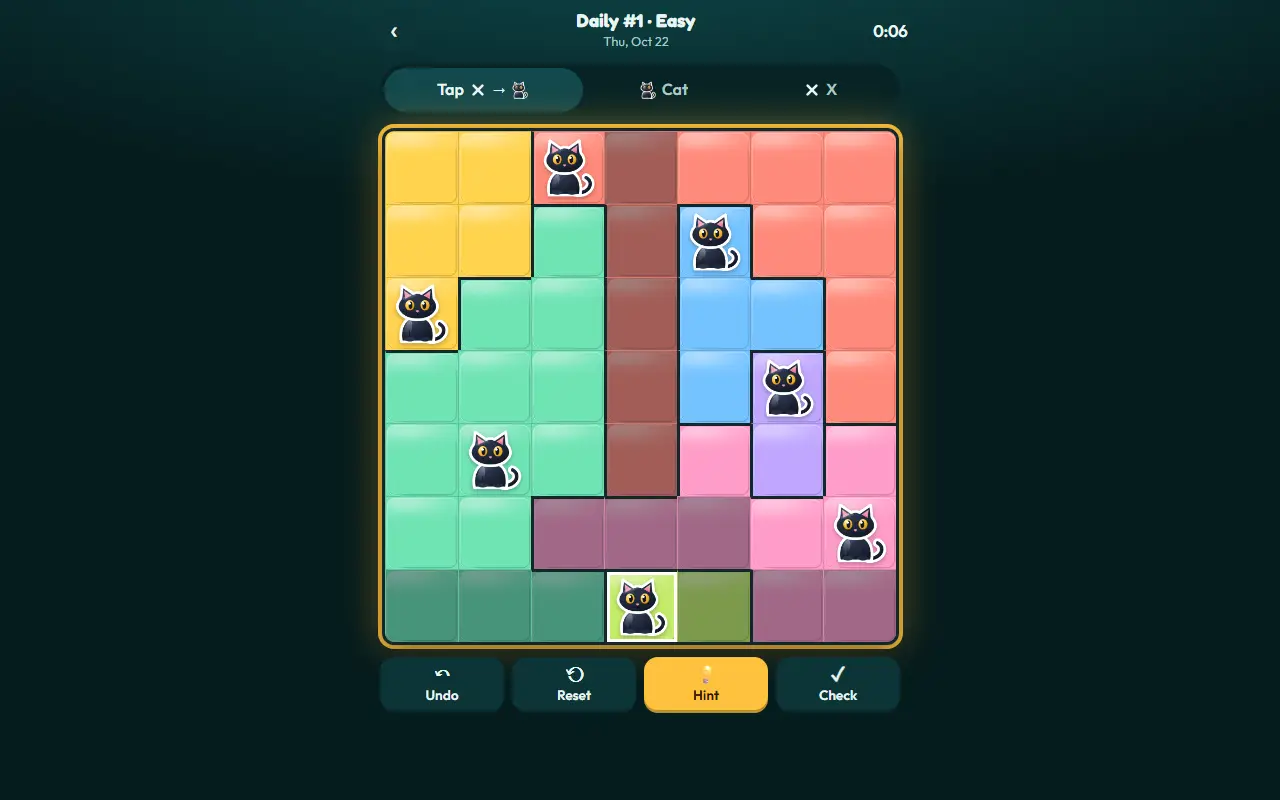
Paws & Plots has only four rules: one cat per row, one per column, one per colored plot, and no two cats touching. Simple rules still leave room for mistakes, and most new players make the same few. Here are the seven we see most, and the habit that fixes each one.
If you want the full rules first, read our Paws & Plots first look.
1. Forgetting the corners
The touching rule includes diagonals. A cat rules out all eight cells around it, not just the four that share an edge. This is the single most common reason a board “almost” works and then falls apart three cats later.
The fix: every time you place a cat, mark all eight neighbors with an X straight away, before you look anywhere else. It takes a second and it saves minutes.
2. Not marking X’s at all
Some players try to hold the whole board in their head. That works on a 7x7 for a while, then breaks down on 9x9 and 11x11.
The fix: use X’s for everything you know. Tap a cell once to mark it with an X. Drag across a row to mark several cells at once. After each cat, cross out its whole row, its whole column, its eight neighbors and the rest of its plot. A board full of X’s shows you where the next cat has to go.
3. Starting in the big plots
Big plots feel important, but they have the most room, which means the most options and the least to deduce.
The fix: start with the smallest plot on the board. A plot of two or three cells has only two or three places for its cat, and often the touching rule or a shared row narrows that to one. Small plots are where nearly every puzzle opens up.
4. Missing the row-and-column trap
When a whole plot sits inside a single row, its cat must be in that row. So no other plot can put a cat there, and every other cell in that row can be crossed out. The same is true for columns, and for two plots that together fill exactly two rows.
The fix: after every few moves, scan for plots that live entirely inside one row or one column. It’s one of the most powerful moves in the game, and it’s easy to overlook. Our solving techniques guide calls it confinement and walks through it step by step.
5. Guessing when stuck
On Medium and Hard, there comes a moment where every cell seems possible. The temptation is to place a cat and see what happens. That usually ends with a broken board and no idea which cat was wrong.
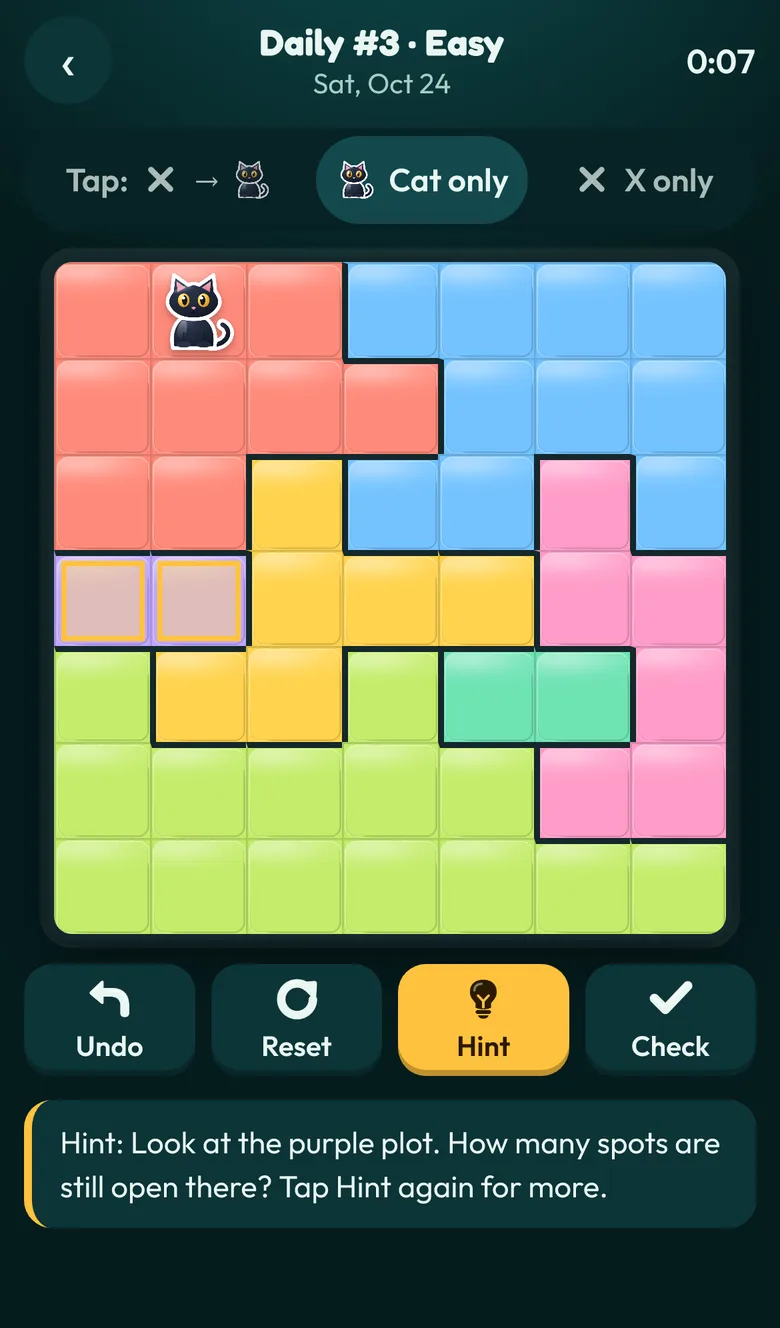
The fix: don’t guess. Every puzzle in Paws & Plots has exactly one answer, and you can always reach it by logic. If you feel you have to guess, there’s a deduction you haven’t seen yet. Press Hint: the first step only points you to the right area, often all you need, and pressing again tells you more before it ever shows the answer.
6. Pressing Check too often
Check looks at your cats and tells you which ones break a rule. It’s useful, but each press counts as a hint (unless the board is still empty). If you’re going for a no-hint solve, a habit of checking after every cat quietly turns your clean solve into a hinted one.
The fix: trust the rules instead. If you’ve crossed out each cat’s row, column, neighbors and plot, a conflict can’t sneak in. Save Check for when something truly feels wrong.
7. Rushing the Hard Daily
The Hard Daily is an 11x11 board with 11 cats. Players who solve Easy in a minute sometimes try to rush Hard the same way, make a slip, and spend longer untangling it than a careful solve would have taken.
The fix: remember that the Daily doesn’t change all day, and there’s no penalty for being slow. Your streak counts any solved Daily. Work Hard slowly, cross out generously, and use Undo the moment you doubt a move. A calm, hint-free Hard solve is one of the best feelings in the game.
A routine that avoids all seven
Put the fixes together and you get a routine that works on every grid size:
- Find the smallest plot and look for its forced cell.
- Place a cat only when it’s certain.
- Cross out its row, column, eight neighbors and plot.
- Scan for plots confined to one row or column.
- Repeat. If nothing is certain, ask for one hint step instead of guessing.
Practice without pressure
If you want to build these habits without touching your Daily results, try Unlimited mode. It has as many puzzles as you want at each size, and nothing about it affects your streak. Our Unlimited mode guide covers how to use it to get faster.
When you’re ready for the main event, read the Paws & Plots Daily guide for streaks, Perfect Days and gold flames.
Play Paws & Plots
Play Paws & Plots free in your browser, with no download. The first time you play, a one-minute guided puzzle shows you the controls.
FAQ
What is the most common mistake in Paws & Plots?
Forgetting that cats can’t touch at the corners. A cat rules out all eight cells around it, including the four diagonals.
Should I ever guess in Paws & Plots?
No. Every puzzle has exactly one answer that logic alone can reach. If you feel you have to guess, there’s a deduction you haven’t spotted yet, and a hint can point you to it.
Does Check count as a hint?
Yes. Each Check counts as a hint, unless there are no cats on the board yet. Use it sparingly if you’re chasing a Perfect Day.
How do I place a cat?
Tap a cell once to mark it with an X, and tap it again to place a cat. You can drag across cells to mark several at once.