How to Solve Sliding Block Puzzles: Tips That Actually Work
Solve any sliding block puzzle faster: work backward from the exit, map each blocker's escape, make the wrong-way move first, and follow a full 7-move example.
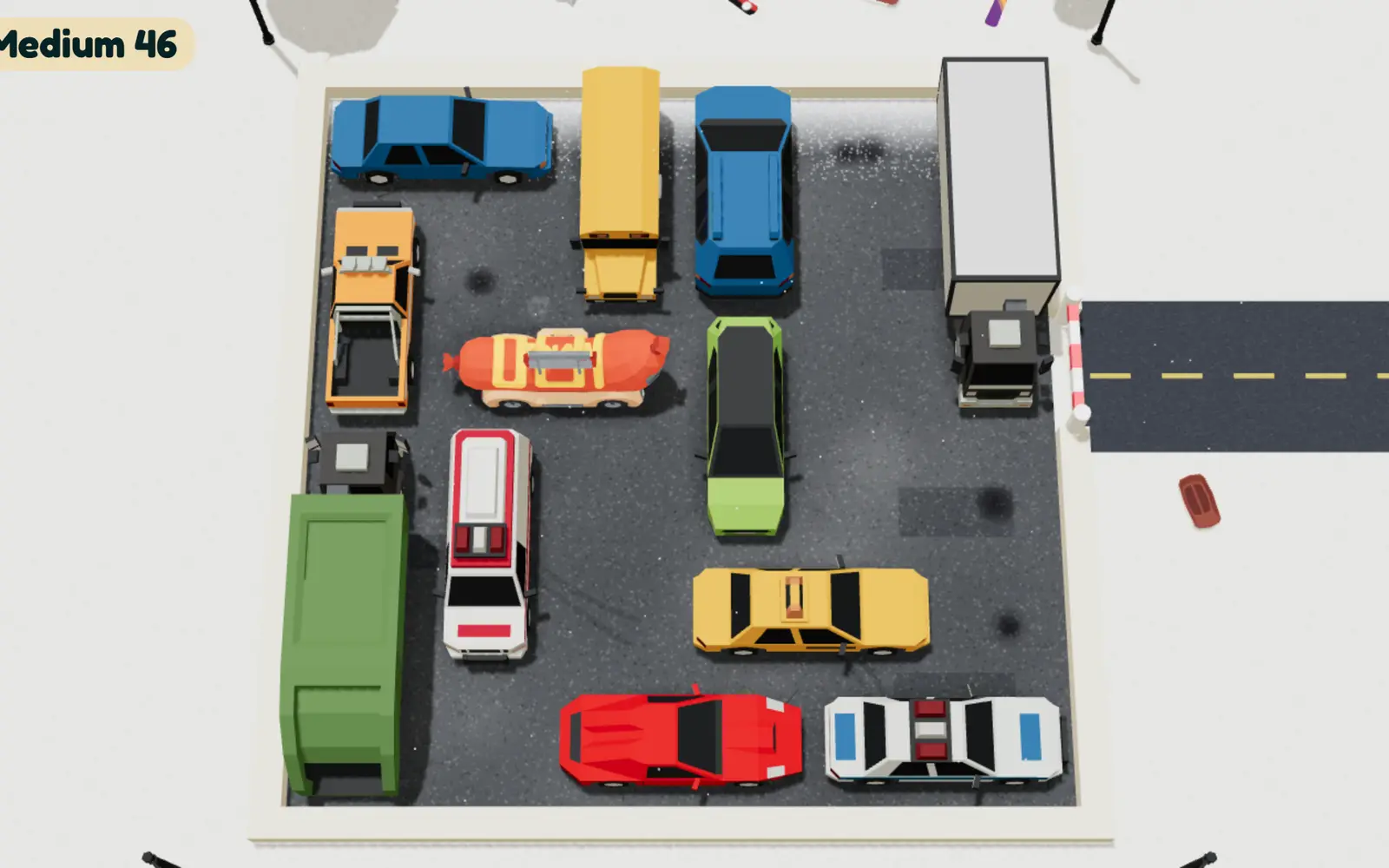
A sliding block puzzle looks like a mess of pieces that can only shuffle back and forth. The trick is to stop shuffling. Start at the goal, figure out exactly what’s in the way, and work backward until you find the first piece that can actually move. Then the solution often reads like a list.
This guide teaches that method, plus the habits that cut your move count, using traffic-jam puzzles as the main example. At the end, there’s a full worked solution on a 6x6 lot. It all applies to Bumper 2 Bumper, our 3D sliding car puzzle that’s coming soon to HulaGames (it isn’t playable yet).
The sliding block puzzle family
Sliding puzzles come in a few flavors:
- Number-tile slides. A square frame of numbered tiles with one gap. Slide tiles into the gap until the numbers are in order.
- Block escapes. Blocks of different sizes in a frame; get the biggest one out through an opening.
- Traffic-jam puzzles. Cars and trucks on a grid, each sliding only along its own lane. Free the target vehicle through the exit.
They share one idea: pieces can’t be lifted, so space is everything. The backward-thinking method below works in all three.
The rules we’ll use
In Bumper 2 Bumper, the lot is 6x6 with the exit on the right of row 3. Cars are 2 spaces long, trucks 3, and each slides only along its own lane. The hot dog cart starts in row 3. One move is one vehicle slid any distance in one direction.
Step 1: Read the exit row
Start with the row your hero needs to cross. List every vehicle that sits in it, from the hero to the exit. Those are your direct blockers.
In Bumper 2 Bumper, nothing else in the hero’s row lies sideways, so every direct blocker is vertical. That means each one must move up or down to get out of the way.
Step 2: Find where each blocker must go
For each blocker, ask: “Where would it have to end up so the exit row is clear?”
Here’s a rule that saves a lot of time on a 6x6 board with the exit in row 3:
- A vertical car (2 long) blocking row 3 can clear it by moving up into rows 1 and 2, or down into rows 4 and 5, or rows 5 and 6.
- A vertical truck (3 long) blocking row 3 can only clear it by moving down into rows 4 to 6. Rows 1 and 2 are just two spaces, so a truck that goes up still covers row 3.
Key takeaway: on this board, a truck in the exit row always has to go down. So the real question is what’s sitting below it.
Step 3: Build the blocker chain
Now go one level deeper. For each blocker’s destination, ask what’s in the way of getting there. Then ask what’s in the way of moving that. Keep going until you reach a vehicle that can move freely right now.
Write it as a chain if it helps: “The cart needs the bus gone. The bus needs to go down. The taxi is below the bus. The taxi can move left.” Now you know your first move: the taxi.
Step 4: Expect the wrong-way move
Medium and hard puzzles usually include a detour: a vehicle that has to move away from where it’s eventually going, to let something else pass, then come back.
If your chain hits a dead end, look for a vehicle that can step aside temporarily. That’s usually the key move of the whole puzzle.
Step 5: Park with care
Where you leave a vehicle matters. A car parked one space too far can block a move you’ll need three steps later. Before you let go, ask: “Does any vehicle in my chain need to pass through here?” If so, slide a little further or the other way.
Step 6: Slide all the way, once
Since one move is one vehicle slid any distance, slide each vehicle straight to its final spot rather than nudging it twice. In Bumper 2 Bumper, sliding the same vehicle again right away counts as the same move, but touching another vehicle in between makes it a new one.
A worked example
Here’s a 6x6 lot. H is the hot dog cart, . is an empty space, and the exit is on the right of row 3.
       c1 c2 c3 c4 c5 c6
  r1   .  .  .  .  C  .
  r2   .  .  .  .  C  .
  r3   H  H  B  .  C  F   -> exit
  r4   .  .  B  D  D  F
  r5   .  .  B  .  .  .
  r6   .  .  .  .  E  E
B and C are vertical trucks, F is a vertical car, and D and E are horizontal cars.
Read the exit row. The blockers are B, C and F.
Where must they go? B and C are trucks, so both must end in rows 4 to 6. F is a car with empty spaces above it, so it can simply go up.
Build the chain. For C to drop into rows 4 to 6 of column 5, both D and E have to leave column 5. E can slide left freely. D can’t go right far enough (F is in the way, and one step right still leaves it in column 5), so D must go left. But column 3 in row 4 is taken by truck B. So B has to get out of row 4 first, and the only way is up, the wrong way, since going down would keep it in row 4.
Here’s the solution:
- B up 2. The truck moves to rows 1 to 3, clearing row 4 in column 3.
- F up 2. The car moves to rows 1 and 2, out of the exit row.
- D left 3. The car slides all the way to columns 1 and 2. Stopping in columns 3 and 4 would block B’s way back down.
- E left 4. Same idea: all the way to columns 1 and 2, so column 3 stays open.
- C down 3. The truck drops into rows 4 to 6 of column 5.
- B down 3. Truck B comes back down, now into rows 4 to 6.
- Cart right 4. The row is clear, and the hot dog cart drives out.
That’s seven moves, and a solver confirms seven is the minimum. Both trucks had to go down, B made a wrong-way move first, and D and E were parked clear of B’s path.
When you get stuck
- Go back to the exit row. Re-list the blockers.
- Undo rather than push on. If you’ve made five moves and nothing improved, undo or reset. In Bumper 2 Bumper, Undo is unlimited.
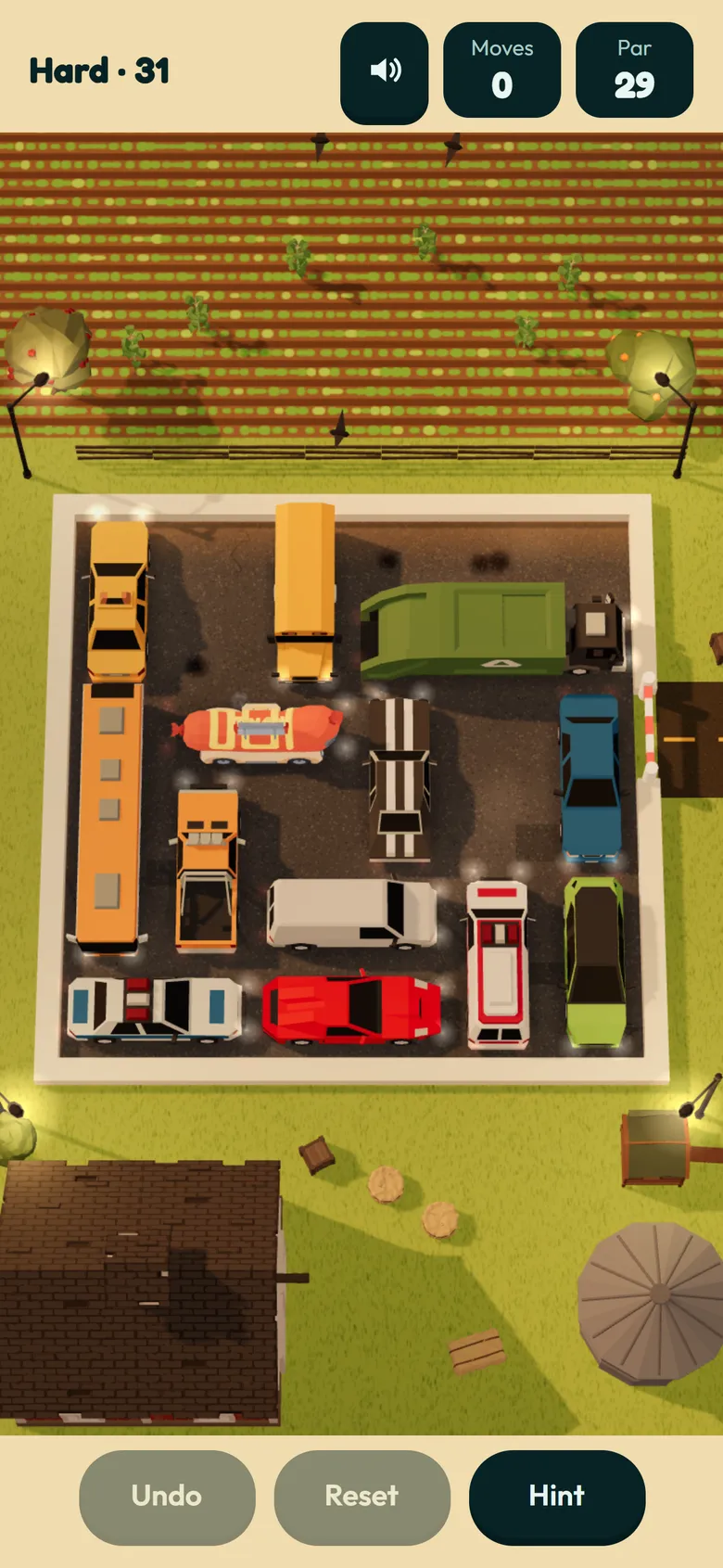
- Use a hint to learn. The planned Hint shows the next vehicle to move from your current position. Ask yourself why it’s that one.
Moves, par and stars
In Bumper 2 Bumper, finishing at par or better earns three stars, and within one and a half times par earns two. Because par is the real minimum, three stars means a perfect line.
The habit that helps most: plan the whole chain before your first move. Most extra moves come from starting before you know where every blocker needs to go.
Ready for the real thing
These techniques work in any traffic-jam puzzle. Read our Bumper 2 Bumper first look for everything we’ve planned, including the Daily Drive. Want a puzzle you can play today? Tiki Tiles rewards the same plan-ahead thinking, and our roundup of free puzzle games has more ideas.
FAQ
What is the trick to sliding block puzzles?
Work backward from the goal. Look at what blocks the exit, then ask where each blocker needs to go and what is stopping it. Follow that chain until you reach a piece that can move freely, then solve from there.
Why do I sometimes need to move a piece the wrong way?
Because a piece often has to step aside to let something else pass, then come back later. Medium and hard sliding puzzles are built around these detours.
How do I solve a sliding car puzzle in fewer moves?
Plan the whole chain before you touch anything, slide each vehicle all the way to where it needs to be in one go, and avoid parking a vehicle where it will block a later move.
What happens if I get stuck?
Undo a few moves or reset and look at the exit row again. In Bumper 2 Bumper, the planned Hint shows the next best vehicle to move from wherever you are.