Logic Puzzles for Beginners: Where to Start
New to logic puzzles? A beginner's guide to the main grid puzzle types, the four techniques behind most of them, and an easy first puzzle to start with.
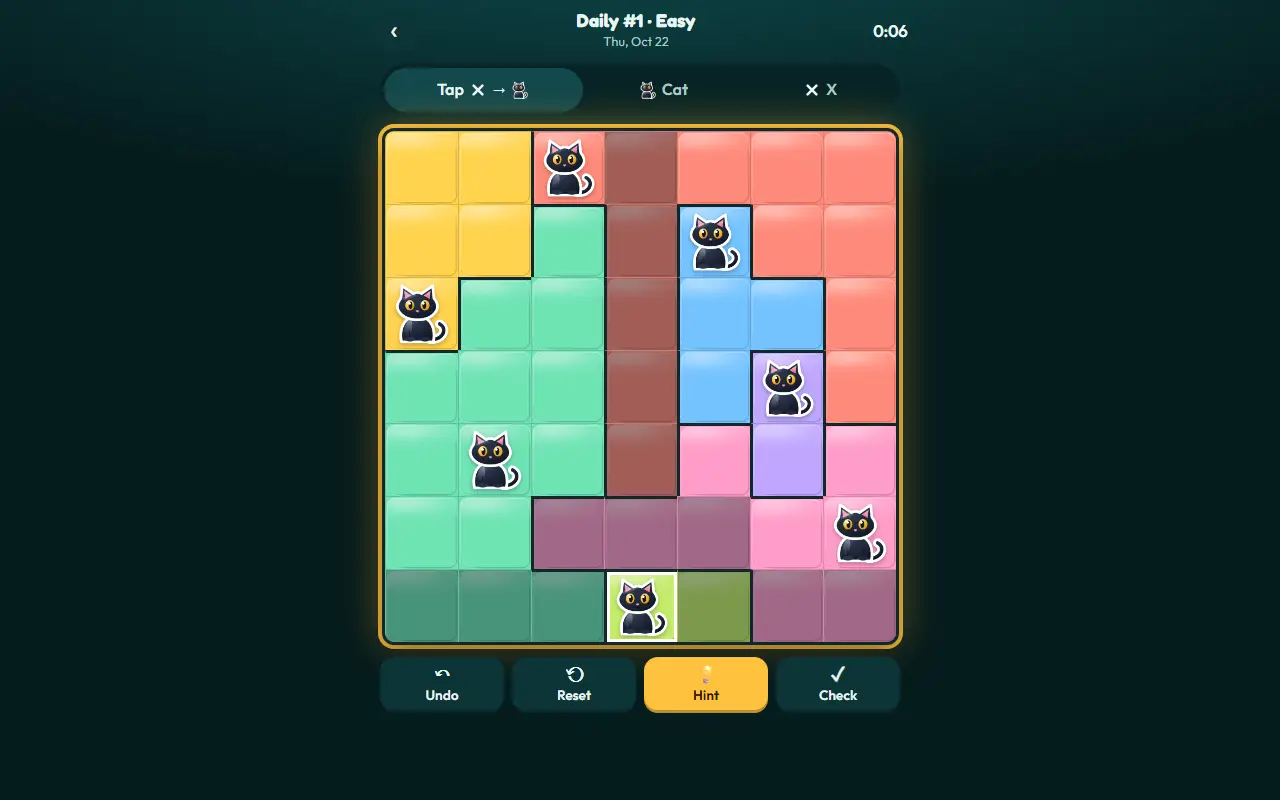
If you’ve ever wanted to try logic puzzles but didn’t know where to start, here’s the good news: most grid logic puzzles run on the same few ideas. Learn to rule things out, spot the cell with only one option left, and test a guess in your head instead of on the board. That covers most of what you need.
This guide to logic puzzles for beginners walks through the main types you’ll meet, the four techniques behind most of them, and a gentle first puzzle to start with.
What makes something a logic puzzle?
A logic puzzle gives you a set of rules and a partly empty board, and asks you to fill it in so every rule is satisfied. Three things set a good one apart:
- Everything you need is on the board. No trivia, no hidden information.
- There’s exactly one answer. If two answers worked, you’d have to guess.
- You can reach it by reasoning. Each step follows from what you already know.
That last point matters most for beginners. A good logic puzzle never asks you to guess. If you feel stuck, there’s a step you haven’t spotted yet, not a coin you need to flip.
The main types of grid logic puzzles
There are hundreds of variations, but most grid puzzles fall into a handful of families.
| Type | What you do | Good for |
|---|---|---|
| Number placement | Fill a grid so each row, column and box holds each number once | Learning elimination |
| Placement puzzles | Place pieces so each row, column and region has one, with spacing rules | A gentle, visual start |
| Picture grids (nonograms) | Shade cells using number clues on each row and column to reveal a picture | Patient, satisfying solves |
| Deduction grids | Match people to things using written clues (“the baker isn’t the oldest”) | Reading and cross-checking |
| Hidden-object grids | Use number clues to work out where hidden items are | Quick bursts of logic |
| Path and loop puzzles | Draw one line or loop that follows the rules | Spatial thinking |
You don’t need to master all of them. Pick one, get comfortable, and you’ll find the skills carry over.
The four techniques behind almost every logic puzzle
1. Elimination
Elimination means crossing out what can’t be true. It’s the backbone of every logic puzzle. In a number grid, if a row already has a 4, no other cell in that row can be a 4. In a placement puzzle, if a piece sits in a column, no other piece can go in that column.
Beginners often keep this in their head. Don’t. Mark it. Most puzzle apps give you a way to note what you’ve ruled out, and using it is the single biggest step up you can make.
2. Singles
When elimination leaves only one possible option, you’ve found a single. That might be a cell with only one number left, or a row with only one place a piece can go.
Here’s a small example from a 4x4 number grid where each row and column holds 1 to 4 once:
row 1: 1 3 ? ?The two blanks need 2 and 4. If the third column already has a 4 lower down, the first blank can’t be 4. So it’s 2, and the last cell is 4. Two cells solved by one cross-out.
3. Confinement
Sometimes a piece or number is trapped. In a placement puzzle, if a region’s open cells all sit in one row, then that row’s piece must belong to that region. Everything else in the row can be crossed out. Confinement is the step that moves you from easy puzzles to medium ones.
4. The short what-if
When nothing else works, take one cell and ask: “If this were true, what would follow?” Follow only the forced steps. If you hit a contradiction, like a row with no options left, the cell is ruled out.
This feels like guessing, but it isn’t. You never commit to the cell. You prove it impossible, cross it out, and move on.
Key takeaway: logic puzzles reward patience more than cleverness. Mark everything, look for the cell with the fewest options, and the puzzle opens up.
A friendly first puzzle: Queens & Cats
If you’re looking for an on-ramp, placement puzzles are a lovely place to start. The rules are short, everything is visual, and you can see each rule at work on the board.
That’s why we’re building Queens & Cats, a daily logic puzzle that’s coming soon to HulaGames (it isn’t playable yet). The rules:
- Place one cat in every row.
- Place one cat in every column.
- Place one cat in every colored territory.
- No two cats may touch, not even diagonally.
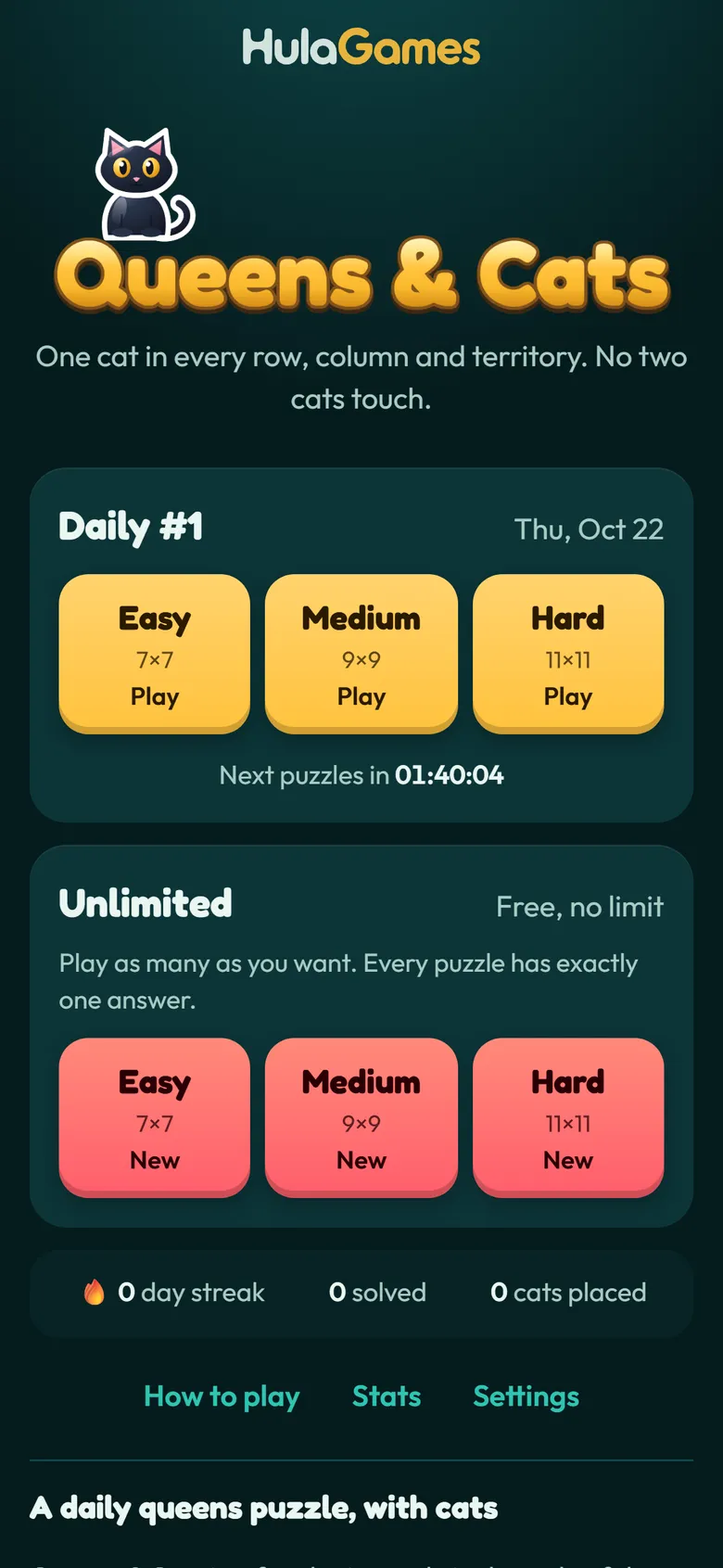
Here’s why we think it suits beginners:
- A short tutorial. The design includes a coached 5x5 puzzle that shows you how to place a cat, see what it rules out, and mark X’s.
- Easy really is easy. Easy dailies are planned on a 7x7 grid and graded to need only the basic techniques: elimination and singles.
- No fail state. You can place and remove cats freely. If two cats break a rule, they wiggle and turn red as a warning, so you learn as you go.
- Hints that teach. The planned hints come in three steps: a Nudge toward the right area, an Eliminate that crosses out one cell and explains why, and a Reveal that places one cat.
- Never a guess. Every puzzle has exactly one answer, reachable by logic alone.
When you’re ready for more, Medium (9x9) and Hard (11x11) are planned to add confinement and short what-if steps. Our guide to how to solve queens logic puzzles teaches all six techniques with a full worked example.
Logic puzzle tips for beginners: your first week
- Start small. A small grid teaches the same ideas with less to keep track of.
- Mark everything. Every X is a clue you won’t have to rediscover.
- Look for the tightest spot. The row, column or region with the fewest options is usually where the next step is.
- Learn one technique at a time. Get comfortable with singles before worrying about what-ifs.
- Use hints to learn, not to finish. When you take a hint, ask why it’s true.
- Play a little each day. A daily puzzle is a good rhythm for building skill. We wrote about building a daily puzzle habit if you want ideas.
Not a logic fan yet? Try a puzzle with a different flavor
If grid logic feels too abstract, start somewhere more hands-on. Tiki Tiles is a relaxing 9x9 block puzzle you can play today, with a Daily board for everyone. It uses the same “look before you place” thinking, with a more forgiving pace.
FAQ
What is the easiest logic puzzle for beginners?
Placement puzzles with a few simple rules are a gentle start, because you can see every constraint on the board. A small grid where you place one piece per row, column and region is a good first step.
Do logic puzzles require math?
Most don’t. Even puzzles that use numbers usually treat them as symbols. What they need is careful elimination: ruling out what can’t be true until only one option is left.
Should I guess when I’m stuck on a logic puzzle?
Try not to. A well-made logic puzzle has one solution you can reach without guessing. When you’re stuck, look for a row, column or region with very few options left, or test one cell with a short what-if.
How do I get better at logic puzzles?
Start with small grids, mark every option you rule out, and learn one technique at a time. A short puzzle every day builds skill steadily without feeling like work.