How to Solve Queens Logic Puzzles: 6 Techniques That Work
Six techniques for any queens logic puzzle: cross-outs, singles, confinement, the touch test, counting groups and what-if checks, with a full worked example.
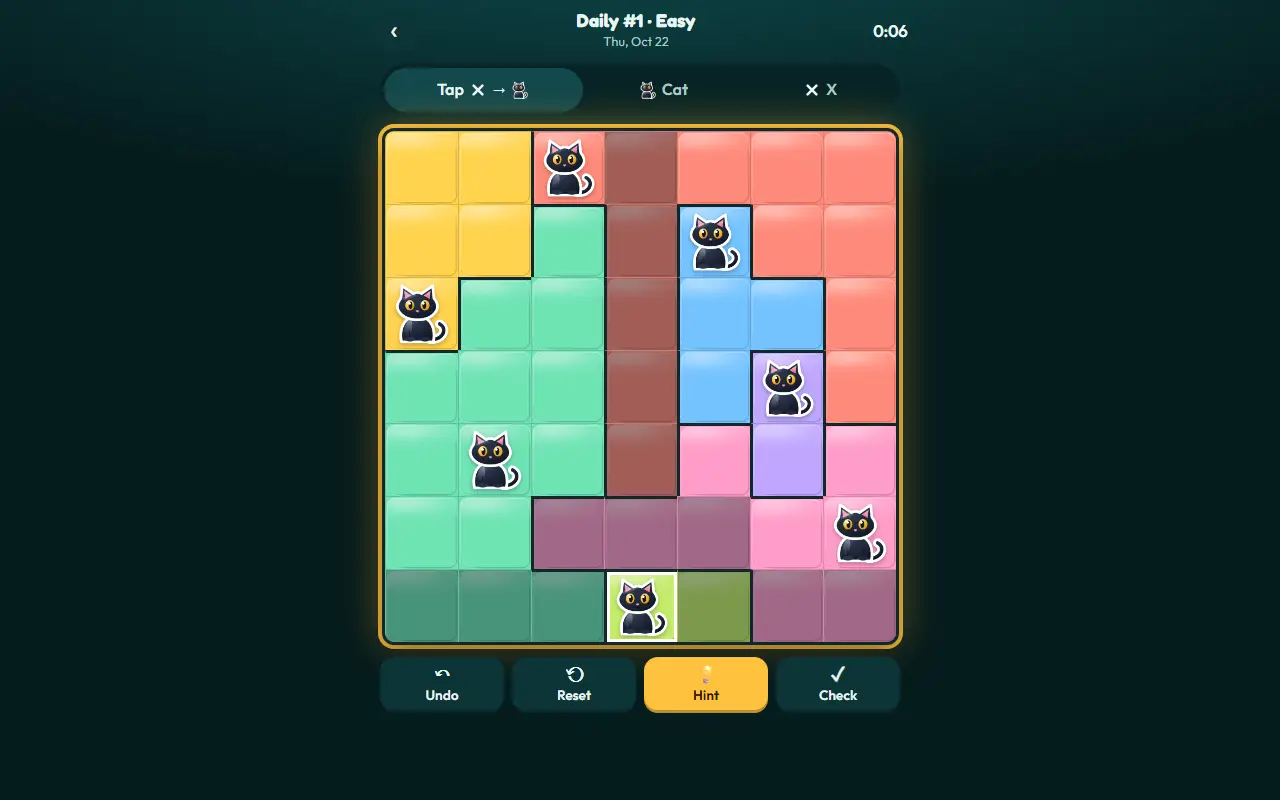
A queens logic puzzle asks you to place one piece in every row, every column and every colored region of a grid, with no two pieces touching, not even at the corners. It looks like it needs guesswork. It doesn’t. A well-made puzzle of this type can be solved by logic alone, and six techniques do almost all of the work.
This guide teaches those techniques with small examples and then walks through a complete 5x5 solve. We use the rules of Queens & Cats, our upcoming daily puzzle (it’s coming soon, not playable yet), where the pieces are cats and the regions are called territories.
The rules in one minute
The puzzle takes its name from the classic eight queens puzzle, which asks how to put eight chess queens on a board so none attack each other. The modern version adds colored regions and swaps long-range attacks for a simpler rule about touching.
In Queens & Cats, a solved grid has:
- Exactly one cat in every row.
- Exactly one cat in every column.
- Exactly one cat in every colored territory.
- No two cats touching, horizontally, vertically or diagonally.
An N by N grid has N territories, so you always place N cats. Every Queens & Cats puzzle has exactly one solution, reachable without guessing.
How the grids below are written: rNcM means row N, column M (row 1 is the top, column 1 the left). Letters in a grid are territories. An X is a cell you’ve ruled out.
Technique 1: Sweep around every cat
Each cat you place rules out a lot of the board. When you place one, cross out:
- every other cell in its row,
- every other cell in its column,
- every other cell in its territory,
- all eight cells touching it.
This sounds obvious, but it’s the technique that makes the others visible. Players who skip their X’s end up re-checking the same cells over and over. In Queens & Cats, a single tap will mark an X and you can drag to mark many cells at once, so sweeping is quick.
Key takeaway: an X is information. The more cells you cross out, the more the next deduction jumps out at you.
Technique 2: Find the singles
A single is a row, column or territory with only one open cell left. That cell must hold its cat.
The easiest singles hide in the smallest territories. A territory with two or three cells has very few options, and one or two cross-outs nearby can leave it with exactly one. So start every puzzle by looking at the small ones.
Check columns too. People scan rows naturally and forget that a column with one open cell is just as forced.
Technique 3: Confinement
Sometimes a territory’s open cells all sit in a single row. That territory must put its cat somewhere in that row. And since the row can only hold one cat, every cell in that row outside the territory can be crossed out.
Here’s a top row where territory A is the first three cells, and A has no cells anywhere else on the grid:
row 1: A A A B BA lives entirely in row 1, so row 1’s cat belongs to A. That means r1c4 and r1c5 (territory B’s cells in row 1) are out.
It works in reverse, too. If a row’s open cells all fall inside one territory, then that territory’s cat is in that row, so the rest of the territory, outside the row, can be crossed out. The same logic applies to columns.
Technique 4: The touch test
Because cats can’t touch, any cell that touches every remaining option of a territory, row or column can’t hold a cat. Whichever option that territory ends up using, a cat on that cell would be touching it.
Two shapes come up all the time:
- Three in a line. If a territory’s options are r1c1, r1c2 and r1c3, then r2c2 touches all three. Cross it out.
- A pair side by side. If the options are r4c2 and r4c3, then r3c2, r3c3, r5c2 and r5c3 each touch both. Cross out all four.
The touch test also explains a handy rule of thumb: cats in neighboring rows always sit at least two columns apart.
Technique 5: Counting groups
Confinement works with one territory and one line. Counting groups scales it up.
Suppose two territories, Blue and Gold, both fit entirely inside rows 6 and 7. Those two territories need two cats, and rows 6 and 7 only hold two cats between them. So both rows’ cats belong to Blue and Gold, and every other territory’s cells in rows 6 and 7 can be crossed out.
The rule in general: if K territories fit entirely within K rows (or K columns), those rows belong to them. And in reverse, if K rows have all their open cells inside K territories, those territories’ cats are in those rows, so cross out their cells everywhere else.
This is the technique that cracks most medium-sized grids once the easy singles are gone.
Technique 6: The short what-if
When nothing else works, test a cell: “If a cat went here, what would follow?” Follow only the forced steps. If one of them leaves some row, column or territory with no open cells, the test cell is impossible. Cross it out.
Here’s a two-step example. Row 4 has two open cells, r4c2 and r4c6. Territory Pink can only go in r6c2 or r6c4. Territory Orange can only go in r7c3 or r7c5.
- Suppose a cat sits on r4c2. That takes column 2.
- Pink loses r6c2, so Pink’s cat is forced onto r6c4.
- A cat on r6c4 touches both r7c3 and r7c5. Orange has nowhere to go.
That’s a contradiction, so r4c2 can’t hold a cat, and row 4’s cat must be on r4c6.
This isn’t guessing. You never commit to the test cell; you prove it wrong in a few steps you can hold in your head. In Queens & Cats, the Hard puzzles are designed to need at least one step like this, and it’s always a short chain, never a deep search.
A full 5x5 solve, step by step
Here’s a complete puzzle. Five territories, labeled A to E:
       c1 c2 c3 c4 c5
  r1   A  A  A  B  B
  r2   D  D  C  B  B
  r3   D  D  C  C  C
  r4   D  D  D  E  E
r5 D E E E E- Confinement. Territory A is r1c1 to r1c3, all in row 1. Row 1’s cat is A’s, so cross out r1c4 and r1c5.
- Touch test. A’s three options all touch r2c2. Cross it out.
- Touch test again. Territory C is r2c3, r3c3, r3c4 and r3c5. The cell r2c4 touches all four. Cross it out.
- Single. Territory B is r1c4, r1c5, r2c4 and r2c5. Three are crossed out, so a cat goes on r2c5.
- Sweep and single. That cat takes row 2 and column 5, and touches r3c4. Territory C’s options were r2c3, r3c3, r3c4 and r3c5; only r3c3 survives. Cat on r3c3.
- Sweep and single. That cat takes column 3 and touches r4c2 and r4c4. Row 4 now has only r4c1 open (r4c5 is in column 5). Cat on r4c1.
- Single. Row 1’s options were r1c1 to r1c3. Column 1 and column 3 are taken, so cat on r1c2.
- Single. Row 5 needs the one column not yet used, column 4. Cat on r5c4, which is in territory E.
The finished grid, with @ for each cat:
       c1 c2 c3 c4 c5
  r1   .  @  .  .  .
  r2   .  .  .  .  @
  r3   .  .  @  .  .
  r4   @  .  .  .  .
  r5   .  .  .  @  .
Check it: one cat per row, one per column, one per territory (A, B, C, D, E), and no two cats touch. Notice that the solve never needed a guess. Confinement and the touch test opened the door, and singles did the rest.
A queens logic puzzle routine you can reuse
When you sit down with a new grid, work through the techniques in order, and go back to the top every time you place a cat:
- Sweep around every placed cat.
- Look for singles in rows, columns and territories.
- Look for territories trapped in one row or column.
- Run the touch test on small territories and short rows.
- Look for counting groups.
- Only then, try a short what-if.
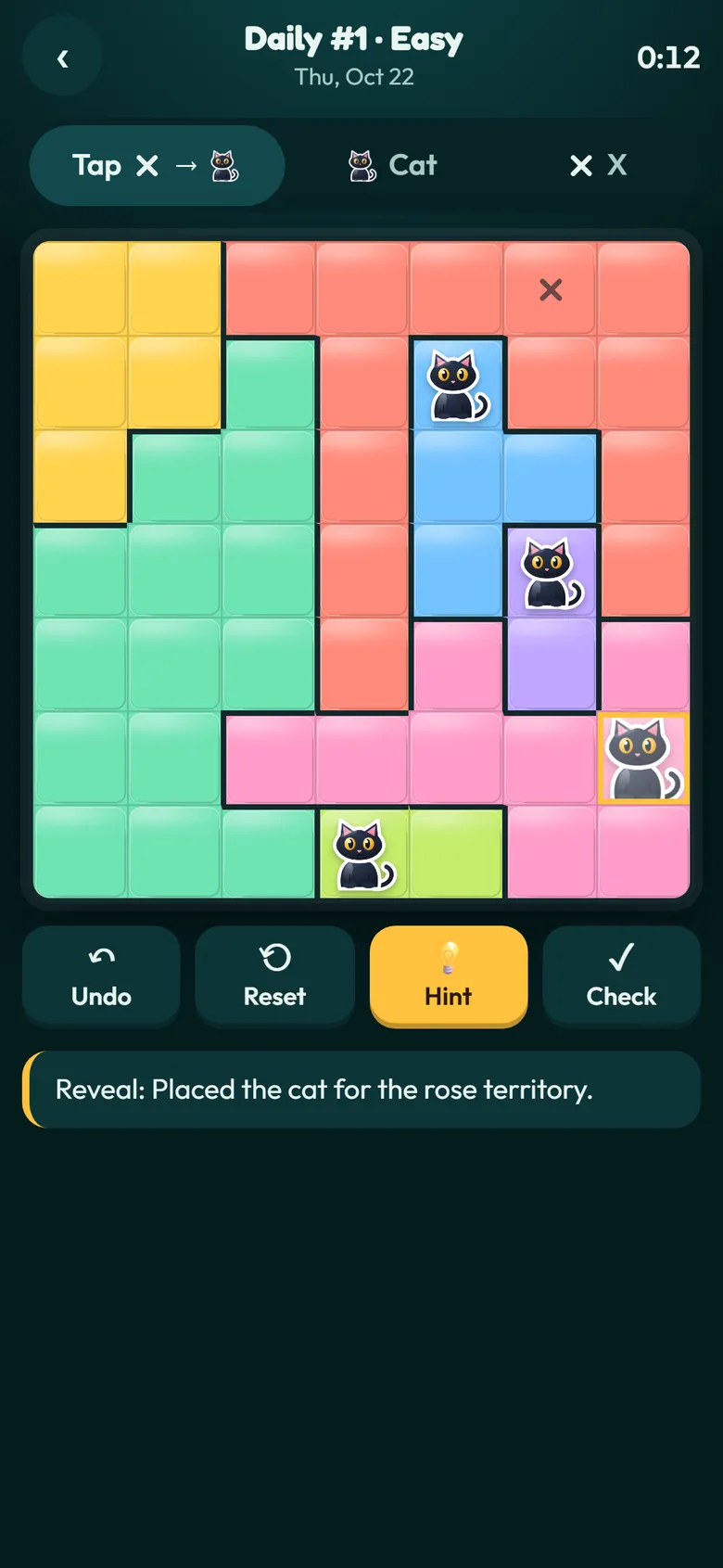
In Queens & Cats, the planned hint system follows the same spirit. Nudge points you to where the next logical step is, Eliminate crosses out one cell and tells you why, and Reveal places one cat. They’re designed to teach the next step, not just hand over the answer.
Get ready for the dailies
These six techniques will carry you through Easy, Medium and Hard. Queens & Cats is planned to have three dailies each day (7x7, 9x9 and 11x11) plus Unlimited mode. Read our Queens & Cats first look for everything we’ve planned, and if grid puzzles are new to you, start with logic puzzles for beginners. A few minutes a day is plenty, as we explain in building a daily puzzle habit.
FAQ
How do you solve a queens logic puzzle?
Start by crossing out every cell that a placed piece rules out, then look for rows, columns or territories with only one open cell. When those run out, look for territories trapped in a single row or column, and cells that touch every option of a territory.
Do you ever need to guess in a queens puzzle?
Not in a well-made one. Puzzles with exactly one solution can be solved by logic. The hardest step is a short what-if check: if a piece went here, would some row, column or territory run out of room?
Where should I start a queens puzzle?
Start with the smallest territories and any territory that sits entirely inside one row or column. They have the fewest options, so they give up information fastest.
What does no two touching mean in a queens puzzle?
No two pieces may be in neighboring cells, including diagonally. So each placed piece rules out all eight cells around it.