10 CRE Tycoon Strategy Tips for a Bigger Portfolio
Ten CRE Tycoon strategy tips for a bigger net worth: build a deal pipeline, read the Deal Sheet, lease up, time refinances and sales, and beat the rivals.

The best CRE Tycoon strategy is simple to say and hard to do well: build a pipeline of broker deals, turn your first commissions into a building that pays, fill it with tenants, then recycle that value through refinancing and sales. Everything points at one number, your net worth when month 120 ends.
These ten tips are built around how the game actually works. If you haven’t played yet, start with our how to play CRE Tycoon guide, then come back here before your second career.
Early-game CRE Tycoon strategy: the broker months
1. Keep more than one deal moving
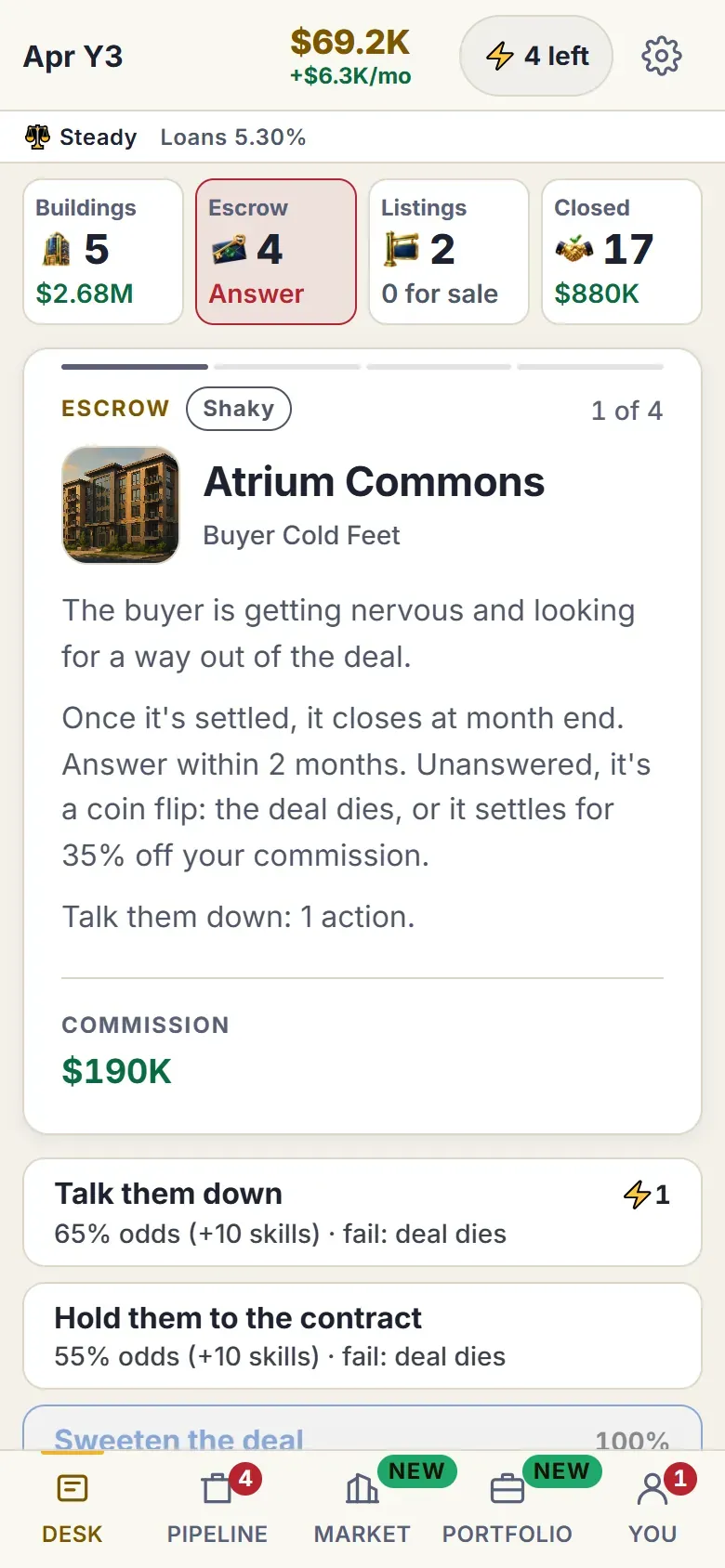
You start with a brokerage and $100,000. Your income comes from commission checks when deals close, and the game models escrow risk, so a deal can fall apart before the money lands.
That’s why one deal at a time is fragile. Work the phones for leads every month and keep several offers going for your buyers. If one falls through, the others keep your cash coming.
2. Treat your first commission as the starting gun
Your first commission opens the market: 275 buildings across four districts, plus 21 landmarks. Until then, you can’t build a portfolio at all.
Getting that first deal closed is the single most important early goal. Every month before it is a month your money can’t compound in buildings.
3. Check your listings every month
Offers on your listings wait for you until you earn Standing Orders. Early on, that means nothing happens with an offer until you look at it. Make checking your listings part of every month, so good offers don’t sit idle.
Buying smart
4. Read all three lines of the Deal Sheet
The Deal Sheet shows what you put in, what the building pays each month and what the seller will likely say. Use all three.
- What you put in tells you how much of your cash a building ties up.
- What it pays each month tells you what that cash earns.
- What the seller will likely say tells you whether an offer is worth making.
Comparing monthly pay against cash in is a quick way to rank buildings. It’s the same instinct behind a real investor’s look at income versus price, which our cap rate guide explains.
5. Don’t waste a month on an offer that won’t land
A career has 120 months, with a few decisions each, so every decision counts. An offer that goes nowhere spends one you could have used elsewhere. If the Deal Sheet says the seller is likely to say no, adjust or move on.
6. Mix property types on purpose
The market includes offices, retail, warehouses and apartments. In the real world, each type earns differently and carries different risks, and a portfolio spread across a few types is less exposed to any one of them. Our beginner’s guide to commercial property types covers why.
Running your buildings
7. Lease up before you chase the next purchase
A building earns from its tenants. Leasing a building up raises what it pays each month, and that income is what funds your next move. It’s tempting to keep buying, but a half-empty portfolio is a slow one.
There’s a second reason to lease up first. If you plan to refinance or sell a building later, you’ll want it working at its best when you do. In real estate, a building with steady tenants and income is simply easier to borrow against and easier to sell.
8. Climb the business plan ladder at your own pace
Business plans run from a quick Fix-Up to a full Redevelop. Bigger plans pay more and carry more risk.
A good rule early in a career: pick plans you can afford to see go sideways. As your cash and portfolio grow, step up the ladder. Upgrades are another lever for making a building work harder, so weigh them against a bigger plan.
Refinancing, selling and the endgame
9. Refinance to recycle cash, sell for the windfall
These are your two big ways to turn a building into money.
| Move | What you get | What you give up |
|---|---|---|
| Refinance | Cash now, and you keep the building | More debt on that building |
| Sell | A windfall; the check shows cash banked and profit | That building’s future income |
Refinancing is how a small stake becomes a large portfolio, because you can pull cash out and buy again without selling. But more debt means less cushion, and the game models market cycles. Our refinancing explainer covers the real-world version of that trade-off.
Selling makes sense when the cash will do more for you elsewhere, or when you’d rather lock in a gain than keep holding.
10. Play for month 120, not this month
Your score is your net worth at the end of the career, and rival investors are racing you for #1. Every big move should answer one question: does this make me worth more when the career ends?
A few practical habits help:
- Watch the market cycle. Conditions change over a career, so the best month to buy or sell isn’t always now.
- Plan around your ranks. There are 14, from Rookie to City Legend, and each promotion brings a new skill, plan, action or district. A new district or plan can change what’s worth doing next.
- Use the hold to confirm. Big moves need a hold on a phone, or two clicks with a mouse. Take that moment to double-check before you commit.
When your career ends, sign in to post your final net worth to the global leaderboard and see how your strategy stacks up.
Put these CRE Tycoon tips to work
You don’t need to master all ten at once. Start with the pipeline, the Deal Sheet and leasing up, and the rest will click as your portfolio grows. CRE Tycoon is free, with no ads and no purchases, and a month takes minutes. Start a career and see how far you can push your net worth, then check today’s quests across HulaGames.
FAQ
What is the best strategy in CRE Tycoon?
Build a steady pipeline of broker deals early, use your first commissions to buy a building that pays well for what you put in, lease it up, then recycle cash through refinancing and sales. Keep your eye on net worth at month 120, since that is your score.
Should I refinance or sell in CRE Tycoon?
Refinancing gives you cash while you keep the building and its income. Selling gives you a windfall and ends that income. Refinance when the building still has more to give, and sell when the cash is worth more to you than holding.
How do I unlock more in CRE Tycoon?
Your first commission opens the market of 275 buildings. After that, climbing the 14 ranks from Rookie to City Legend brings a new skill, plan, action or district with each promotion.
How do I beat the rivals in CRE Tycoon?
Rival investors race you for #1 by net worth. Compound early, avoid losing months to deals that fall apart, and make sure your big moves late in the career add to what you’re worth when month 120 ends.