How to Play CRE Tycoon: From Broker to Real Estate Empire
New to CRE Tycoon? Learn how a 10-year career works, from your first commission to buying, leasing, refinancing and selling buildings for a top net worth.

CRE Tycoon is a commercial real estate tycoon game you play in your browser. You start with a small brokerage and $100,000, close deals for buyers, then use your commissions to buy buildings of your own. Over a 10-year career, played one month at a time, you lease those buildings up, refinance them, sell them and try to finish with the biggest net worth in the city.
This guide walks you through the whole loop in the order you’ll meet it: your first months as a broker, your first purchase, running buildings, and the end-of-career race. If you only read one section, read “The core loop,” because everything else hangs off it.
A quick note on where it comes from: we’re an independent studio in San Diego, and our founder also runs a commercial real estate brokerage there. That’s why the game uses real terms like cap rate and NOI, simplified so a month fits in a coffee break.
What kind of game is CRE Tycoon?
CRE Tycoon is a single-player tycoon and strategy game. There’s nothing to download and no reflex test. Each month you get a few decisions, you make them, and you end the month to see what happened.
Here is the shape of a career at a glance:
| Part of the career | What you do | What you’re after |
|---|---|---|
| Early months | Work leads, make offers for buyers, close deals | Commission checks and your first real cash |
| First purchase | Use the Deal Sheet to size up a building and buy it | Monthly income and a foothold in the market |
| Middle years | Lease up, run business plans, buy upgrades | Higher income and a more valuable portfolio |
| Late game | Refinance or sell, keep buying | Grow net worth and beat the rivals |
| Month 120 | Career ends | Your net worth is your score |
The key idea: every system in the game feeds one number, your net worth when the 120th month ends.
Starting your CRE Tycoon career
Before your first month, you name yourself and your firm. Then you open the doors with $100,000 and no buildings. You’re a broker, not a landlord yet, so your first job is to make deals happen for other people.
Work the phones
Your early months are about leads. You work the phones to find buyers and opportunities, then make offers on behalf of your buyers. When a deal makes it all the way to closing, you collect a commission check.
Not every deal closes. The game models escrow risk, so a deal in progress can still fall apart before the money lands. That’s realistic, and it’s a good reason to keep more than one deal moving at a time.
Your first commission opens the market
Your first commission is a milestone. It opens the market: 275 buildings across four districts, plus 21 landmarks. The mix covers offices, retail, warehouses and apartments, so you’ll see very different kinds of property as you browse.
If you want a primer on how those asset types differ in the real world, our beginner’s guide to commercial property types on the blog covers the basics in plain words.
How to buy your first building
Buying is where CRE Tycoon turns from a brokerage game into an empire game. The tool you’ll lean on most is the Deal Sheet.
Read the Deal Sheet
The Deal Sheet shows three things for any building you’re eyeing:
- What you put in (your cash into the deal).
- What it pays each month.
- What the seller will likely say to your offer.
That third line matters. It saves you from wasting a month on an offer that has no chance, and it shows you when there’s room to push.
Use the real math
The game includes loans, cap rates and NOI in simplified form. If those terms are new, two quick reads will help a lot:
- What is a cap rate? explains how income and price relate.
- Net operating income, explained covers the income number that cap rates are built on.
You don’t need to be a finance person to play. But knowing why one building pays more per dollar than another makes your Deal Sheet decisions faster and better.
Big moves need a hold
Buying a building is a big move, so the game asks you to confirm it. On a phone, you hold the button. With a mouse, you click once and click again. It’s a small thing that saves a lot of “oops” moments.
The core loop: lease, improve, refinance, sell
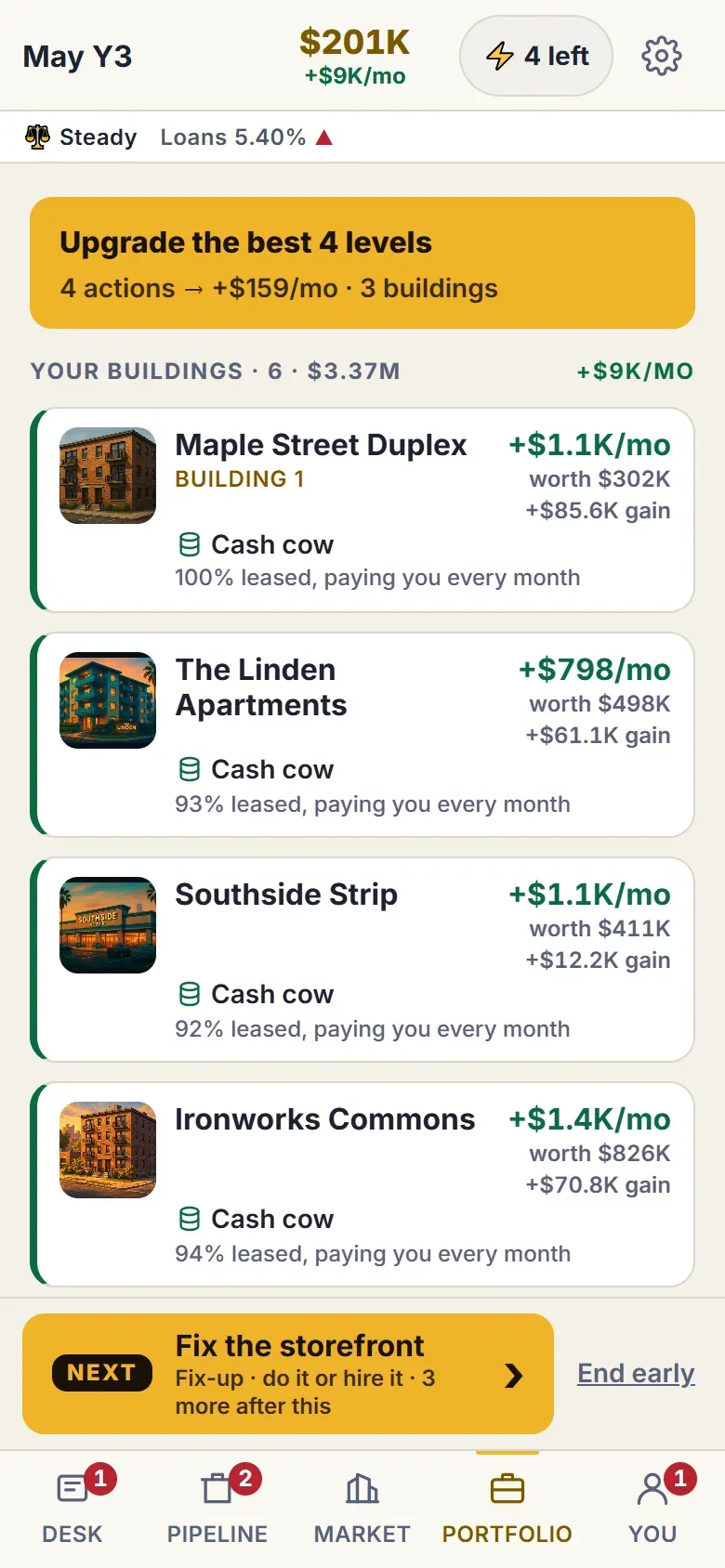
Once you own a building, the official one-line version of the game kicks in: buy buildings and fill them with tenants, then refinance and sell to grow your portfolio. Here’s what each step means in play.
Lease buildings up
An empty building doesn’t pay much. Leasing it up, which means filling it with tenants, is how you raise what it earns each month. In real estate, steadier income usually supports a higher value too, which is worth keeping in mind before you refinance or sell.
Run business plans
Business plans are a ladder. At the bottom is a quick Fix-Up. At the top is a full Redevelop. Bigger plans pay more and carry more risk, which is exactly how value-add investing works in real life.
A sensible early approach is to start on the lower rungs while your cash is thin, then climb the ladder as you can absorb a plan that doesn’t go perfectly.
Buy upgrades
You can also buy upgrades for your buildings. Think of them as targeted spending that makes a property work harder, separate from a full business plan.
Refinance for cash
Refinancing lets you take cash out of a building without selling it. In the game, that cash goes straight back to work on your next purchase. It’s one of the most powerful moves you have, and also one of the easiest to overdo, because more debt means bigger payments. Our refinancing explainer covers how it works and where it goes wrong.
Sell for the windfall
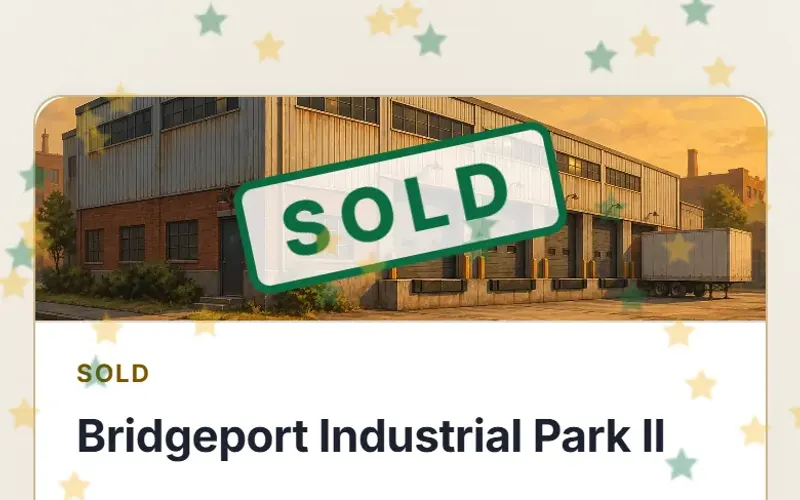
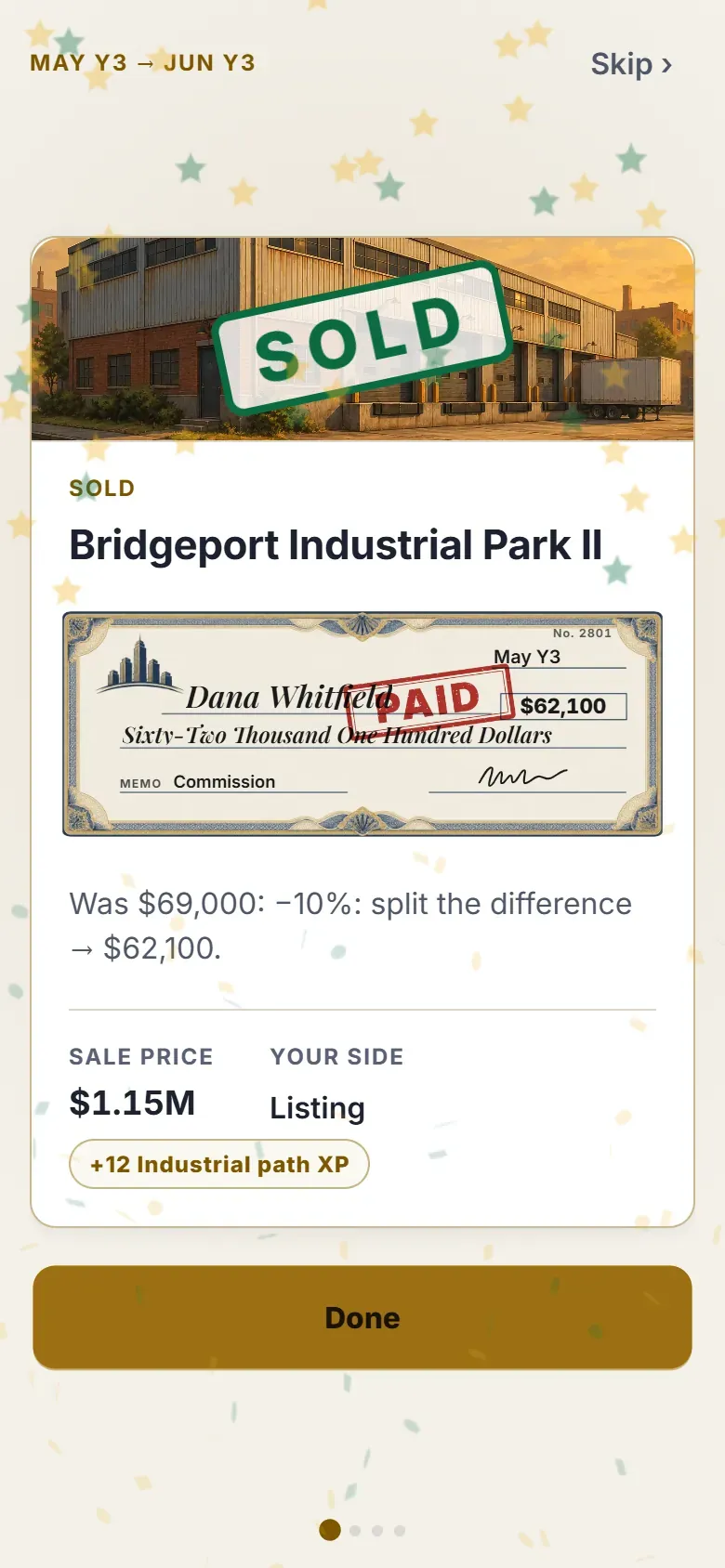
Selling turns a building into a lump of cash. When a sale closes, your check shows the cash you banked, with the profit below it, so you can see exactly what the deal did for you.
Listings are part of your brokerage work too. Offers on your listings wait for you until you earn Standing Orders, so early on, make a habit of checking them each month.
Ranks, rivals and market cycles
Climb 14 ranks
Your career has 14 ranks, from Rookie to City Legend. Each promotion brings something new: a skill, a business plan, an action or a district. Ranks are how the game keeps opening up across the decade, so the late game plays differently from your first year.
Race the rivals
You’re not alone in the city. Rival investors are racing you for #1. They give the game its pressure: a strong year for you might still leave you chasing someone else.
Watch the market cycle
CRE Tycoon models market cycles. Conditions change over a career, so a purchase or sale that looks average one year can look very different in another. Treat the market as something to read, not something to ignore.
How the career ends and how you’re scored
A career lasts 120 months, or 10 in-game years. When the last month ends, your net worth is your score. Net worth means what you own minus what you owe, so it’s a bigger picture than the cash in the bank.
If you sign in, you can post your final net worth to the global leaderboard. Signing in is optional: you can play the whole career as a guest.
The key idea: refinancing and selling both turn buildings into cash, but only what you end up worth counts. Think about month 120, not just this month.
Beginner tips for your first career
A few habits make your first run smoother:
- Keep several deals moving. Escrow risk means some deals fall through. A pipeline beats a single bet.
- Read the seller line on the Deal Sheet. It tells you how hard you can push before you make an offer.
- Fill vacancies before you chase the next purchase. Tenants are where a building’s monthly income comes from.
- Climb the business plan ladder gradually. Bigger plans pay more but carry more risk.
- Refinance with a plan for the cash. Pull money out when you have a good place to put it.
- Play at your own pace. A month takes minutes, and your save sits in your browser between sessions.
For a deeper set of ideas, read our CRE Tycoon strategy tips.
Ready to build your empire?
CRE Tycoon is free, has no ads and no purchases, and runs on your phone or desktop browser. Start a career, close your first deal and see how far $100,000 can go in 10 years. When you’re done, browse the rest of our free games and today’s quests.
FAQ
Is CRE Tycoon free to play?
Yes. CRE Tycoon is free in your browser, with no ads and no purchases. You can start a career right away without an account.
How long is a game of CRE Tycoon?
A career lasts 120 months, which is 10 in-game years. Each month takes minutes, so you can play a few months on a break or a whole career in one sitting.
How do you win CRE Tycoon?
Your score is your net worth at the end of month 120. Rival investors are racing you for #1 in the city, and you can post your final net worth to a global leaderboard.
Do I need an account to play CRE Tycoon?
No. You only need to sign in if you want to post your score to the global leaderboard. Your save lives in your browser on your device, so clearing your browser data deletes it.
Can I play CRE Tycoon on my phone?
Yes. It was built for phones first and has a full desktop layout too. You tap or click to play, and big moves use a hold button so you don’t confirm them by accident.